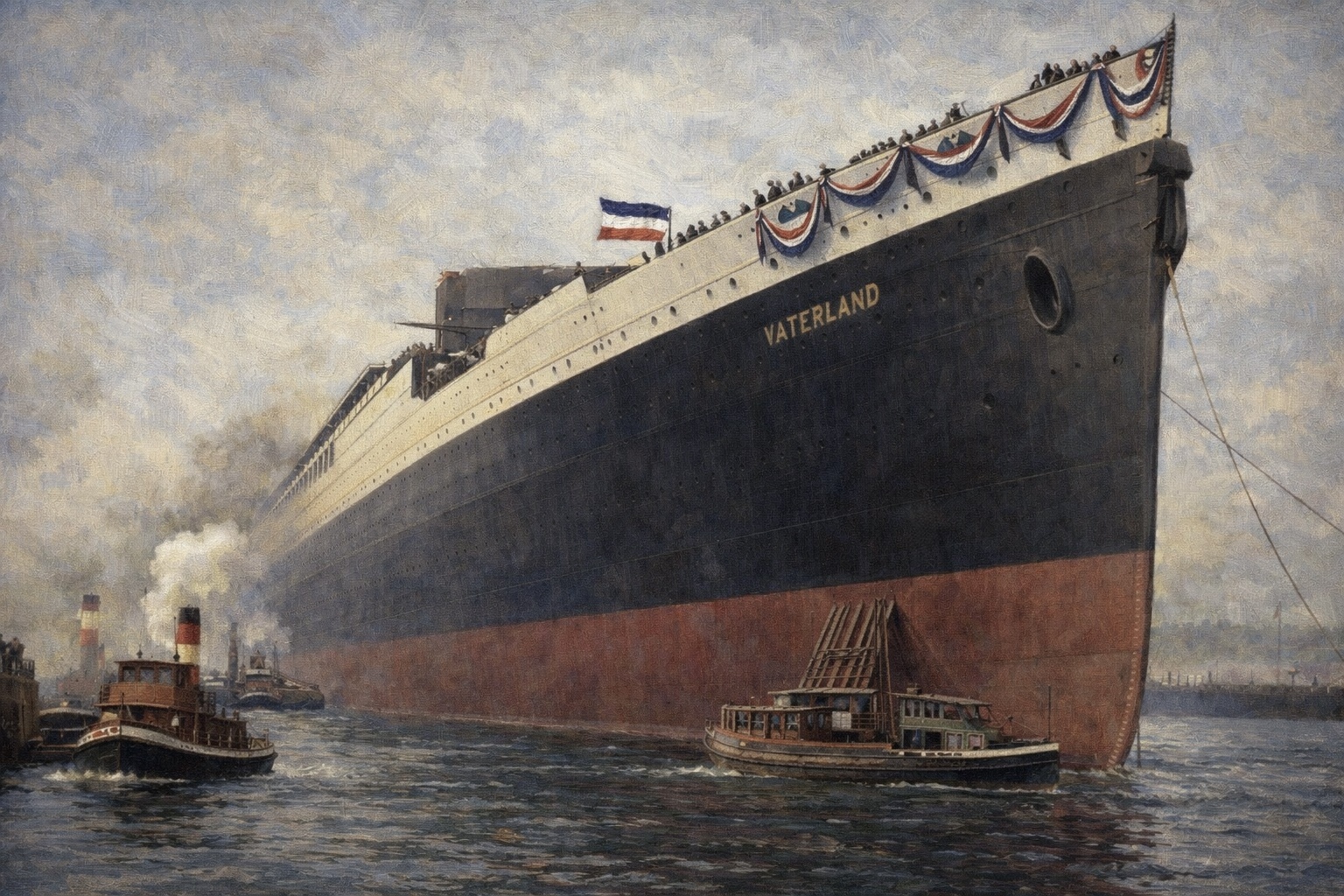
This page is a focused chronology rather than a full interpretive essay. It follows the ship from her construction and launch as
Vaterland, through wartime seizure, troopship service, rebuilding as
Leviathan, commercial Atlantic service, and eventual withdrawal and scrapping.
For room-by-room interpretation, collecting material, and related features, use this page as the chronological backbone and branch outward.
Date note: some milestones are straightforward and well documented, while others are better understood as broad phases rather than one exact moment.
Where necessary, this page preserves that distinction instead of flattening everything into false precision.
Naming note: the ship’s story crosses identities and flags. Early entries use Vaterland; later entries use Leviathan. That change is part of the historical story, not just a label swap.
Filters
Toggle categories to narrow the page by construction, war service, rebuilding, passenger service, or decline and disposal.
⌕
Tip: Search matches section, date, title, description, and category tags.
Built for Hamburg America Line, Vaterland emerges as one of the great German prestige liners of the prewar era. Size, visibility, and symbolic national weight are central to her story from the beginning.
Spring 1914
Fitting out and preparation for North Atlantic service
Construction
Interiors, passenger accommodations, and operating arrangements are completed for regular transatlantic work. In this phase, the ship exists as a luxury statement as much as a transport asset.
May 1914
Vaterland enters passenger service
ConstructionPassenger service
The ship begins Atlantic crossings under the Hamburg America Line banner. In reputation and public profile, she belongs to the brief late-imperial world of giant liners before war rearranges everything.
Mid-1914
A giant liner in a tense world
Passenger service
Even before war formally interrupts operations, the ship’s scale and nationality make her unusually vulnerable to geopolitical change. Her peacetime identity proves fragile.
1914–1919 · Internment, seizure, and troopship service
August 1914
Vaterland is laid up in New York as war begins
War service
With the outbreak of the First World War, the ship becomes effectively stranded in the United States. This moment halts her intended commercial life and begins the long transformation away from her original German identity.
1914–1917
Internment period in New York
War service
For years the ship remains inactive while political conditions shift around her. In timeline terms, this is less a dramatic episode than a suspended one: a giant liner waiting for state action to decide her fate.
April 1917
The United States seizes the ship
War service
After the United States enters the war, the interned liner is taken over. This is the decisive break in ownership, function, and symbolism: the German flagship liner becomes an American wartime asset.
Curator note
This is one of the page’s clearest identity-change points. A Leviathan timeline works best when it treats seizure not as a side note, but as the central hinge in the ship’s life.
1917
Conversion for troop transport begins
War serviceRebuild
Interior luxury gives way to military utility. The ship is adapted for large-scale movement of personnel rather than peacetime passenger comfort, an early example of how radically her purpose could be recast.
1917–1918
Troopship service across the Atlantic
War service
In American hands the former Vaterland carries large numbers of troops. This phase reshapes the ship’s public meaning: no longer an imperial German showpiece, she becomes part of the U.S. war effort and victory narrative.
1919
Postwar transport and transition out of wartime service
War service
As the war closes, the ship’s future shifts again. The question is no longer how to use her militarily, but what peacetime role can justify operating such a large and expensive vessel.
1920s · Rebuilding and American flagship service
Early 1920s
Reconditioning for commercial service under the name Leviathan
Rebuild
The ship is refitted for peacetime operation and enters a new public life as Leviathan. The name itself signals scale, ambition, and American ownership in a way that deliberately distances the vessel from her German past.
1923
Leviathan begins service for United States Lines
RebuildPassenger service
Reborn as a major American liner, the ship resumes regular Atlantic crossings. In cultural terms, she now functions as a kind of floating national flagship for the United States merchant marine.
1920s peak years
Prestige crossings and public visibility
Passenger service
Leviathan becomes widely known for her scale, interiors, and symbolic status. For your site, this is where public rooms, postcards, menus, and ephemera pages naturally link outward from the timeline.
Mid- to late 1920s
Operational strain and mixed reputation
Passenger service
However impressive the ship looked on paper, operating a vessel of this scale was costly and not always efficient. The timeline should acknowledge that grandeur and practicality did not always move together.
Curator note
This is a good place to resist overly celebratory liner rhetoric. A strong Leviathan page keeps the tension between prestige and operating reality visible.
Late 1920s
Changing travel economics begin to press on the ship’s future
Passenger serviceDecline
The ship’s immense size, maintenance demands, and commercial environment make long-term sustainability harder to defend. The seeds of withdrawal are already present before the Depression fully bites.
1930s · Decline, lay-up, and scrapping
Early 1930s
Depression-era conditions worsen the ship’s commercial outlook
Decline
The Great Depression reduces passenger demand and makes costly liner operation harder to justify. For a vessel already burdened by scale, the economic climate is especially damaging.
Mid-1930s
Leviathan is withdrawn from active service
Decline
By this point the ship’s future as a working liner has effectively ended. The withdrawal is not a dramatic disaster ending, but a commercial and structural dead end.
1930s
Proposals, uncertainty, and no real second act
Decline
Like many famous liners, Leviathan invites hindsight speculation about what might have been done with her. In practice, preserving or repurposing such a giant ship was difficult, and the timeline should reflect that economic reality.
Late 1930s
Sold for scrap and dismantled
Decline
The ship’s long life closes not with heroic preservation but with disposal. That ending is important in its own right: it helps explain why surviving material culture, photographs, postcards, fittings, and ephemera matter so much to later Leviathan research.
Continue Exploring Leviathan
Use the timeline as the backbone, then move outward into interiors, conversion, and collecting material.