Part of the SS Leviathan topic collection
Leviathan is often remembered for scale first: she was one of the largest liners of her era, and that sheer magnitude shaped her interiors as much as any decorative scheme did. Her public rooms matter because they show how a giant liner was made socially intelligible. Passengers did not experience a ship only as tonnage, horsepower, or national prestige. They experienced it through dining rooms, lounges, halls, stairways, cafés, and smoking rooms. On Leviathan, those spaces also carried the added interpretive interest of a ship whose identity had shifted from Vaterland to Leviathan, bringing continuity, alteration, and recontextualization into the story of the interiors themselves.
Originally launched as Vaterland, later completed in American service as Leviathan and remembered as one of the great large liners of the interwar Atlantic.
Public rooms translated an enormous ship into usable spaces for dining, leisure, circulation, and class-structured passenger life.
Leviathan’s broad reputation rests heavily on the size and impressiveness of her principal first-class rooms and shared social spaces.
At a glance: the rooms most worth remembering
How to read Leviathan’s public rooms
Leviathan’s interiors are best understood not as isolated masterpieces but as parts of a very large interior machine. Some rooms mattered because they impressed. Others mattered because they organized movement, gave passengers places to linger, or made class distinctions materially visible. In a ship of this scale, successful interior design had to do more than look rich. It had to keep the passenger world coherent.
Inherited grandeur
Leviathan’s interior history cannot be separated from her earlier life as Vaterland. That gives the ship an especially interesting design story shaped by continuity, change, and reinterpretation.
Americanized presentation
In service as Leviathan, interiors also became part of how the United States presented one of its flagship Atlantic liners to the traveling public.
Sectional drawing: seeing Leviathan from the inside
These sectional views are especially useful because they show Leviathan not simply as a profile or a list of rooms, but as a stacked interior system. They help make visible the relationship between machinery, circulation, deck levels, boat stowage, and the large passenger spaces discussed below.
Bow, lower structure, and forward accommodation
This portion helps show how the ship’s forward end balanced hull form, working structure, and habitable interior volume. It is a useful reminder that even a celebrated passenger liner remained an engineered organism whose public rooms sat within a much larger structural framework.
The social core of the ship
The central section is perhaps the most revealing for this page, because it shows how Leviathan’s principal public interiors sat within the middle of a very large vessel. It helps explain why rooms such as lounges, halls, and dining spaces should be read not as isolated decorative set pieces, but as part of a coordinated interior arrangement at giant scale.
Upper deck life and the ship’s rearward spaces
This section gives a clearer sense of how passenger areas, open deck arrangements, and the stern structure related to one another. It adds interpretive depth by showing that Leviathan’s interior world extended well beyond a few famous rooms into a full, layered environment of movement, service, and social use.
Why this matters: For a ship like Leviathan, sectional drawings do something photographs alone cannot. They reveal relationships between spaces. They show how public rooms, service zones, machinery, and circulation all belonged to one integrated system — which is exactly why Leviathan’s interiors are best understood as a sequence of connected environments rather than as detached individual rooms.
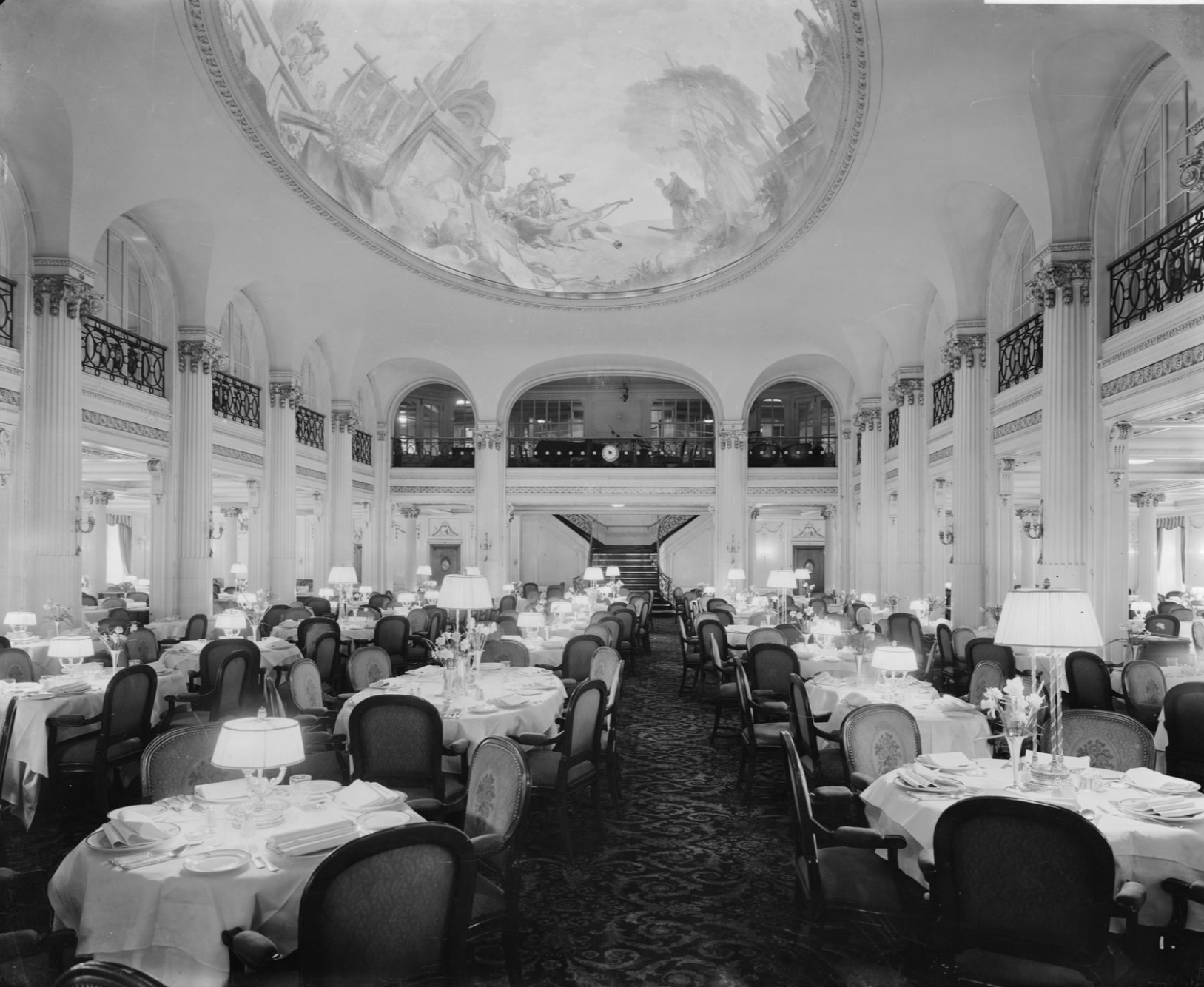
The Main Dining Saloon
Scale centerpieceIf one wants to understand Leviathan as more than a famous name or a giant hull, the dining saloon is one of the best places to start. Dining was one of the most visible rituals of transatlantic travel, and on a ship this large the main dining room became both an operational achievement and a social performance. It had to feed many people efficiently while still sustaining an atmosphere of order, prestige, and ritual.
That makes the room historically valuable even when it is not always the single most reproduced interior in popular memory. A giant liner proved itself through systems, and the main dining saloon was one of the clearest places where Leviathan’s size became legible to passengers.
- Shows how shipboard luxury depended on organization as much as decoration.
- Turns abstract scale into a visible, inhabited passenger environment.
- Helps explain why giant liners impressed not just visually but socially.
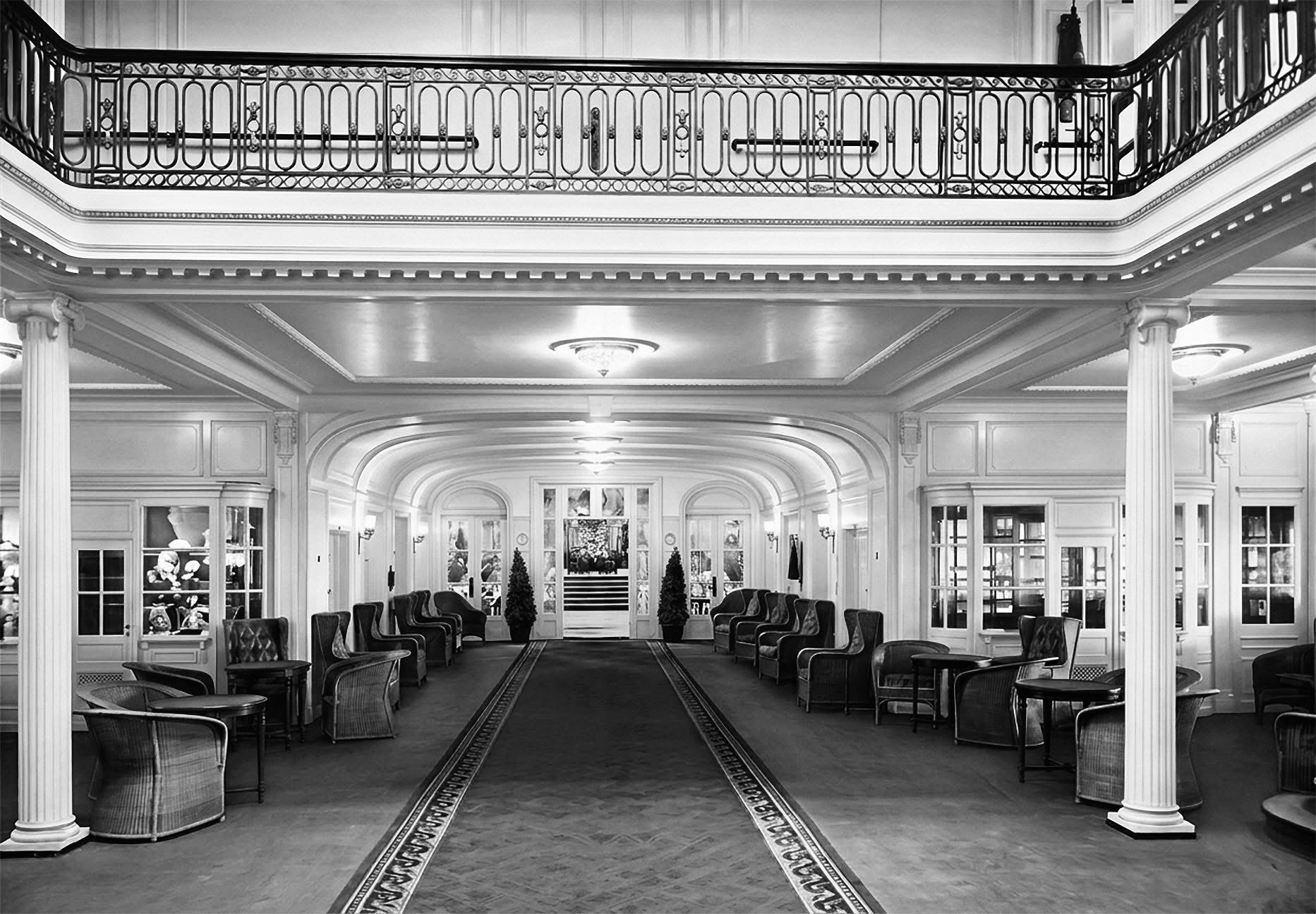
The Entrance Hall or Grand Hall
First impressionOn a ship as large as Leviathan, the spaces of arrival mattered enormously. An entrance hall or grand hall was not merely transitional. It set the emotional and decorative register for what followed. It gave passengers a first sense of whether the ship felt imposing, hospitable, fashionable, or overwhelming.
Rooms of this kind often matter less because of one single decorative feature than because they mediate the whole interior experience. They are the spaces where scale is translated into atmosphere, where the voyage shifts from embarkation procedure to the feeling of being aboard a great liner.
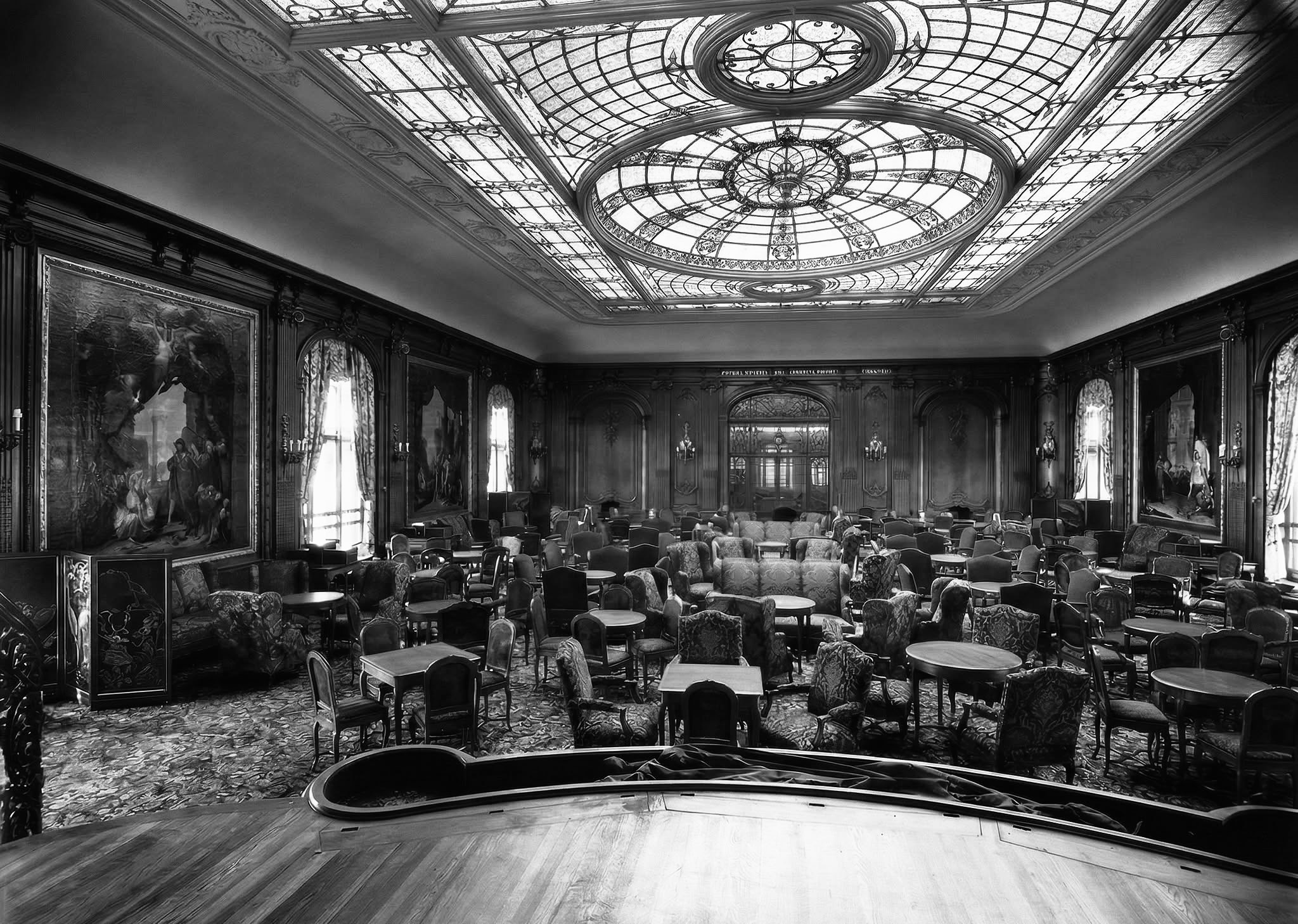
The First-Class Lounge
Cultivated leisureThe first-class lounge matters because it reminds us that prestige at sea was not achieved only through grand set pieces. Passengers also needed places to remain: to sit, talk, read, observe, and pass time in surroundings meant to feel cultivated rather than merely spectacular.
On Leviathan, such spaces helped temper the scale of the ship. A large liner could easily feel impersonal if every major room emphasized only magnitude. The lounge worked differently. It made the ship feel inhabitable.
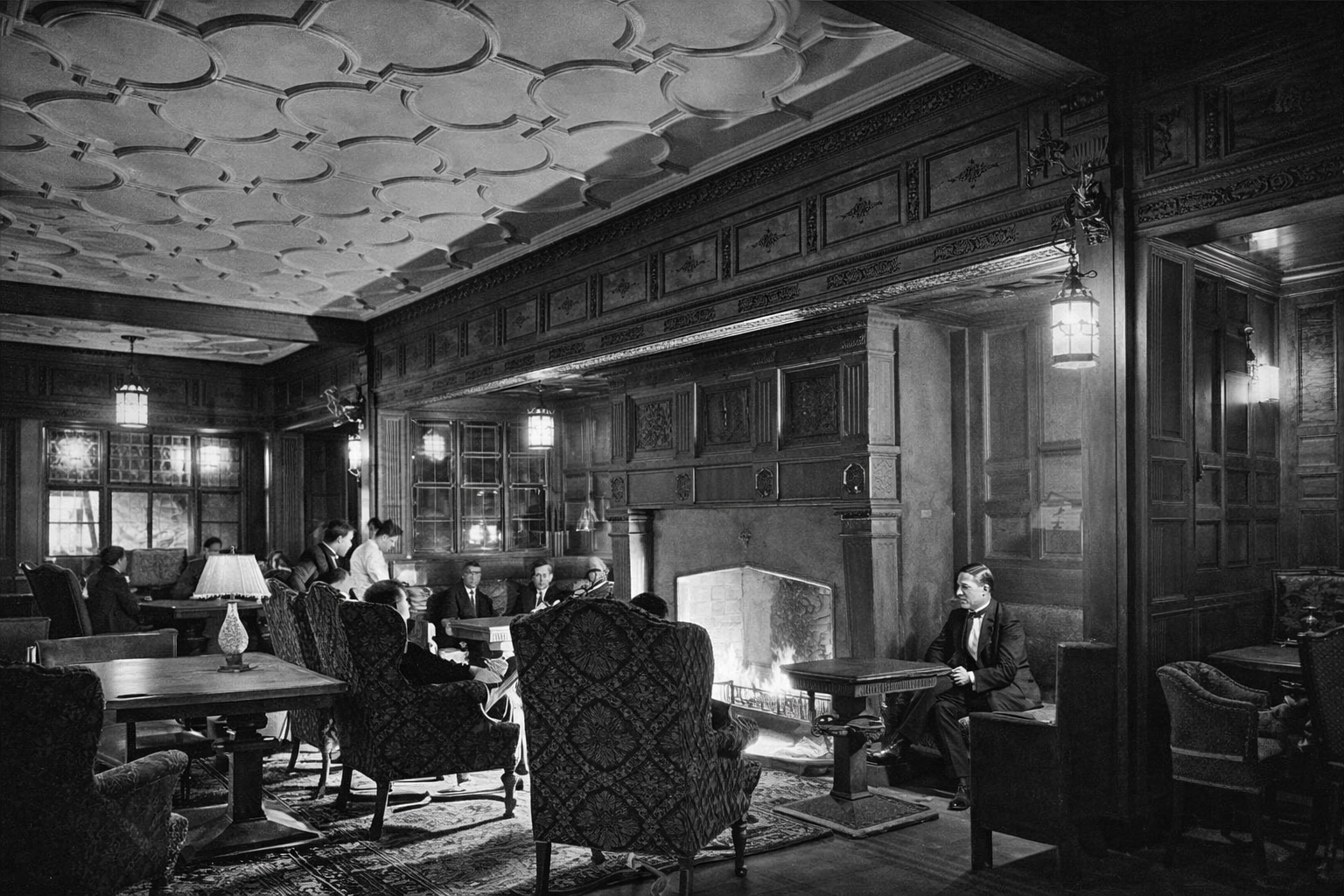
The Smoking Room
Atmospheric roomLike the smoking rooms of other major liners, Leviathan’s smoking room likely carried much of the ship’s masculine social identity. These spaces are often memorable because they feel highly specific: darker, more enclosed, and more ritualized than adjacent lounges or cafés.
Their significance lies in atmosphere as much as architecture. They helped stage a particular vision of elite travel: after-dinner sociability, card tables, tobacco, club manners, and a world that felt parallel to prestigious land-based interiors.
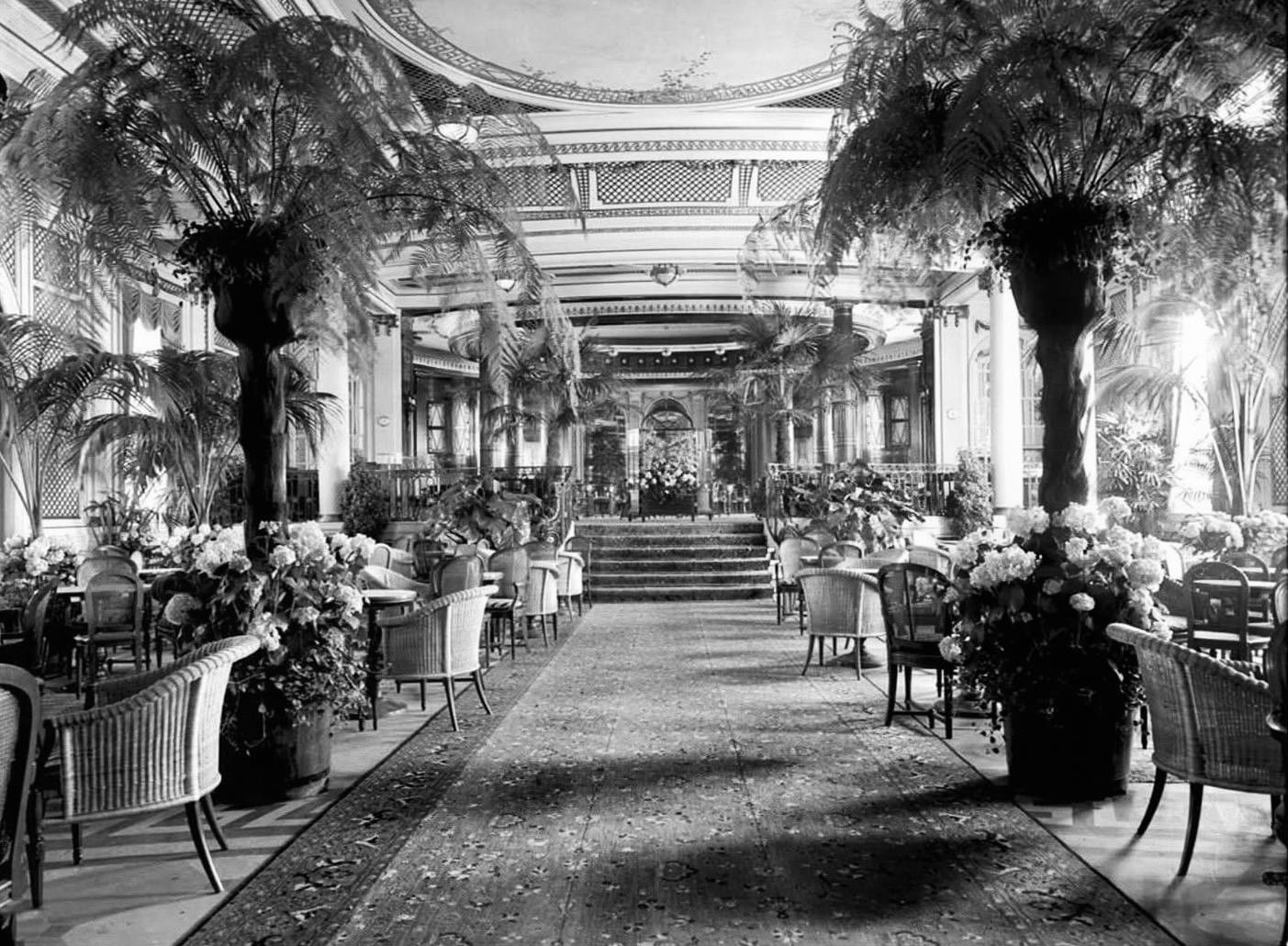
Palm Garden or Café-Type Social Spaces
Fashionable easeGiant liners needed variety. Not every memorable room could be monumental or solemn. Lighter public spaces—whether called palm gardens, cafés, or similarly informal social rooms—helped keep the ship from feeling decorative in only one register.
These rooms mattered because they offered ease. They introduced a more relaxed cadence into the passenger experience and helped make Leviathan feel fashionable rather than merely large.
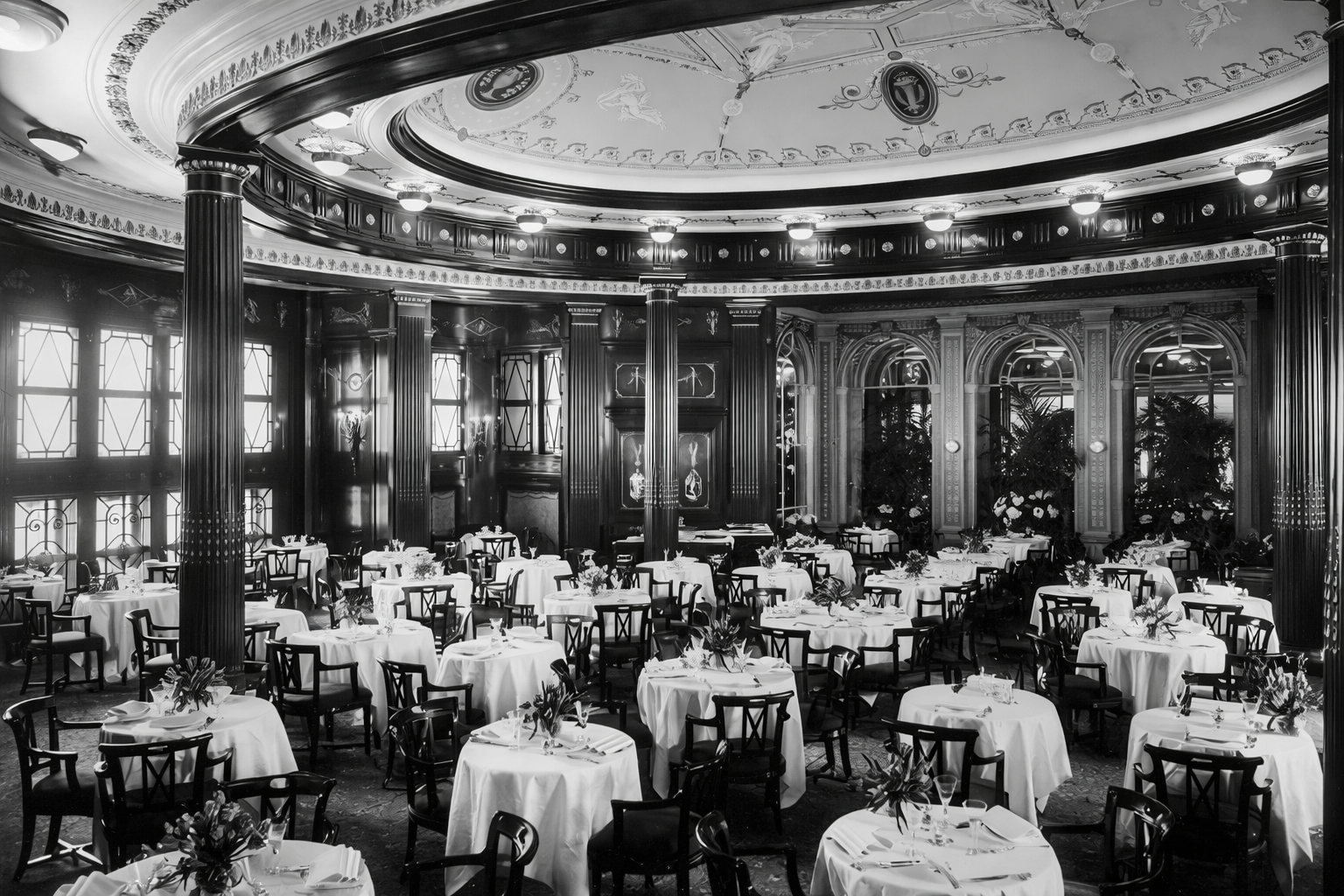
The Ritz-Carlton Room
Restaurant luxuryThe Ritz-Carlton Room is especially revealing because it points to a more modern and specialized form of liner luxury than the main dining saloon alone could provide. On a ship as large as Leviathan, prestige did not depend only on one giant ceremonial room. It also depended on offering passengers a range of experiences, including interiors that felt more exclusive, more personal, and more closely tied to fashionable metropolitan dining culture.
That is what makes the Ritz-Carlton Room so useful interpretively. It suggests a shipboard world in which first-class life was not simply grand, but curated. Rather than relying only on magnitude, the room helped create distinction through mood and selectiveness. It gave Leviathan a dining interior that could feel more socially pointed: less about massed ritual, and more about cultivated ambiance.
In that sense, the room helps broaden the picture of Leviathan’s public interiors. It reminds us that great liners were not only floating halls of spectacle. They also borrowed from elite hotel and restaurant culture, translating fashionable land-based luxury into a transatlantic setting.
- Shows how Leviathan’s luxury included variety as well as size.
- Helps connect liner interiors to elite hotel and restaurant culture ashore.
- Adds a more intimate, selective register to the ship’s public-room story.
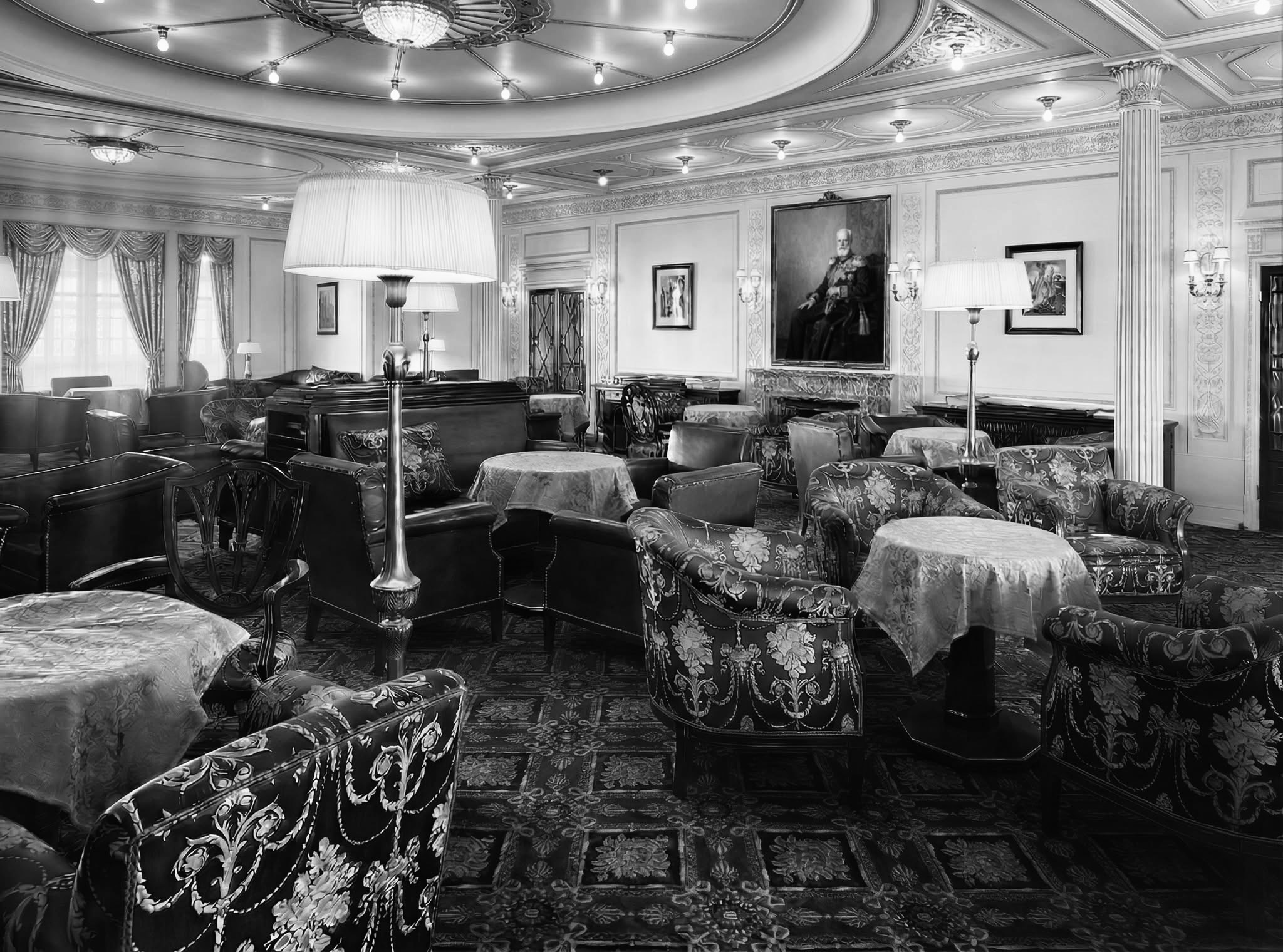
Writing and Reading Rooms
Quiet refinementPublic-room history can easily become overweighted toward the biggest interiors. Writing and reading rooms help correct that imbalance. They supplied privacy without actual isolation, and usefulness without losing decorative dignity.
On a long Atlantic crossing, such rooms were not trivial extras. They helped the ship feel complete. A liner of status needed spaces for display, but it also needed spaces for routine, correspondence, and composure.
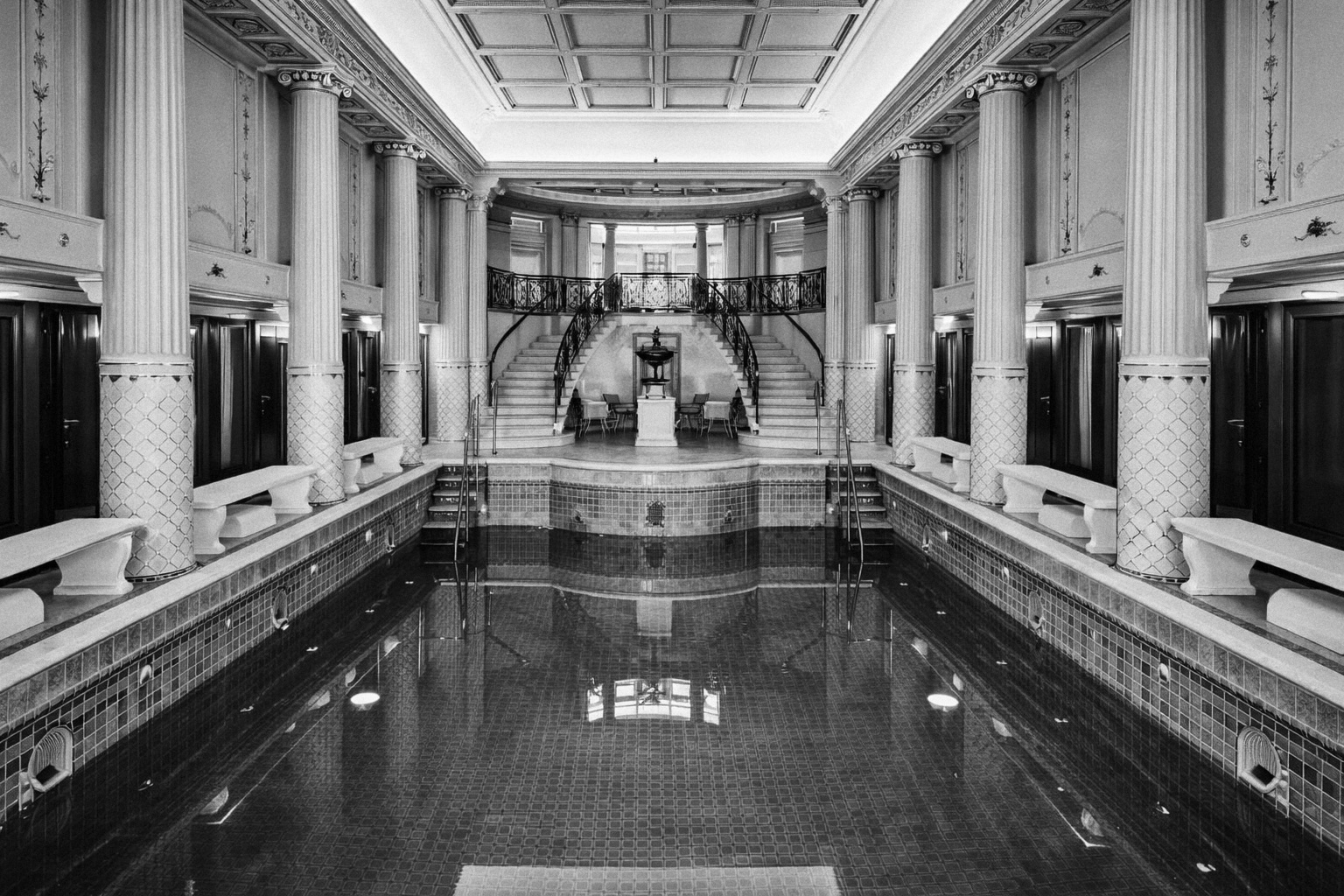
The Swimming Pool
Modern amenityThe swimming pool matters because it helps place Leviathan within a more fully developed world of twentieth-century liner luxury. By the interwar period, prestige at sea was not expressed only through dining rooms, lounges, and grand halls. It was also expressed through amenities that suggested health, leisure, bodily comfort, and modern living. A pool gave passengers access to an experience associated with advanced hotel culture and high-end recreation rather than merely transportation.
On Leviathan, this kind of space broadened the emotional range of the interior world. It introduced a setting centered less on ceremony and more on activity, refreshment, and novelty. That mattered because giant liners increasingly had to offer more than impressive architecture. They had to promise a complete environment: one in which passengers could dine, promenade, socialize, rest, and also participate in modern forms of leisure.
The pool is therefore significant not only as a memorable feature in itself, but as evidence of how ocean liners absorbed the expectations of luxury hospitality ashore. It suggests a ship trying to feel comprehensive, up to date, and generously equipped for prolonged passenger life.
- Shows Leviathan participating in a broader culture of modern luxury amenities.
- Adds recreation and bodily comfort to the story of the ship’s interiors.
- Helps explain how major liners competed by offering a fuller onboard lifestyle.
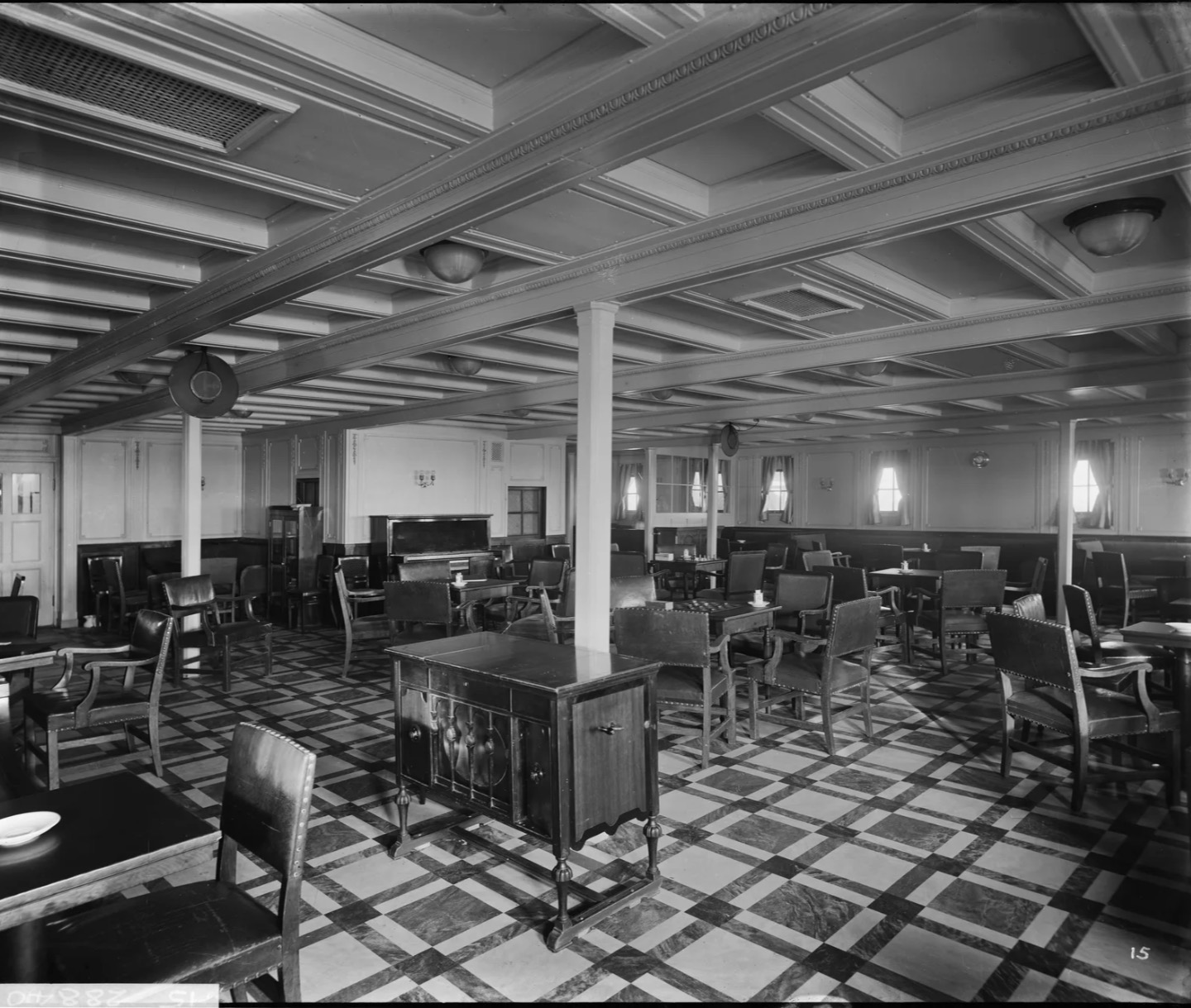
Tourist or Cabin-Class Public Rooms
Wider passenger storyIt is easy to tell liner history entirely through the most glamorous first-class rooms, but that produces a partial picture. Leviathan’s broader passenger accommodation also mattered. Public rooms outside first class helped define the ship’s commercial range and its appeal to a wider traveling public.
Including them makes the interior story more honest. It reminds us that a transatlantic liner was a layered social system, not just a floating palace for the most privileged passengers.
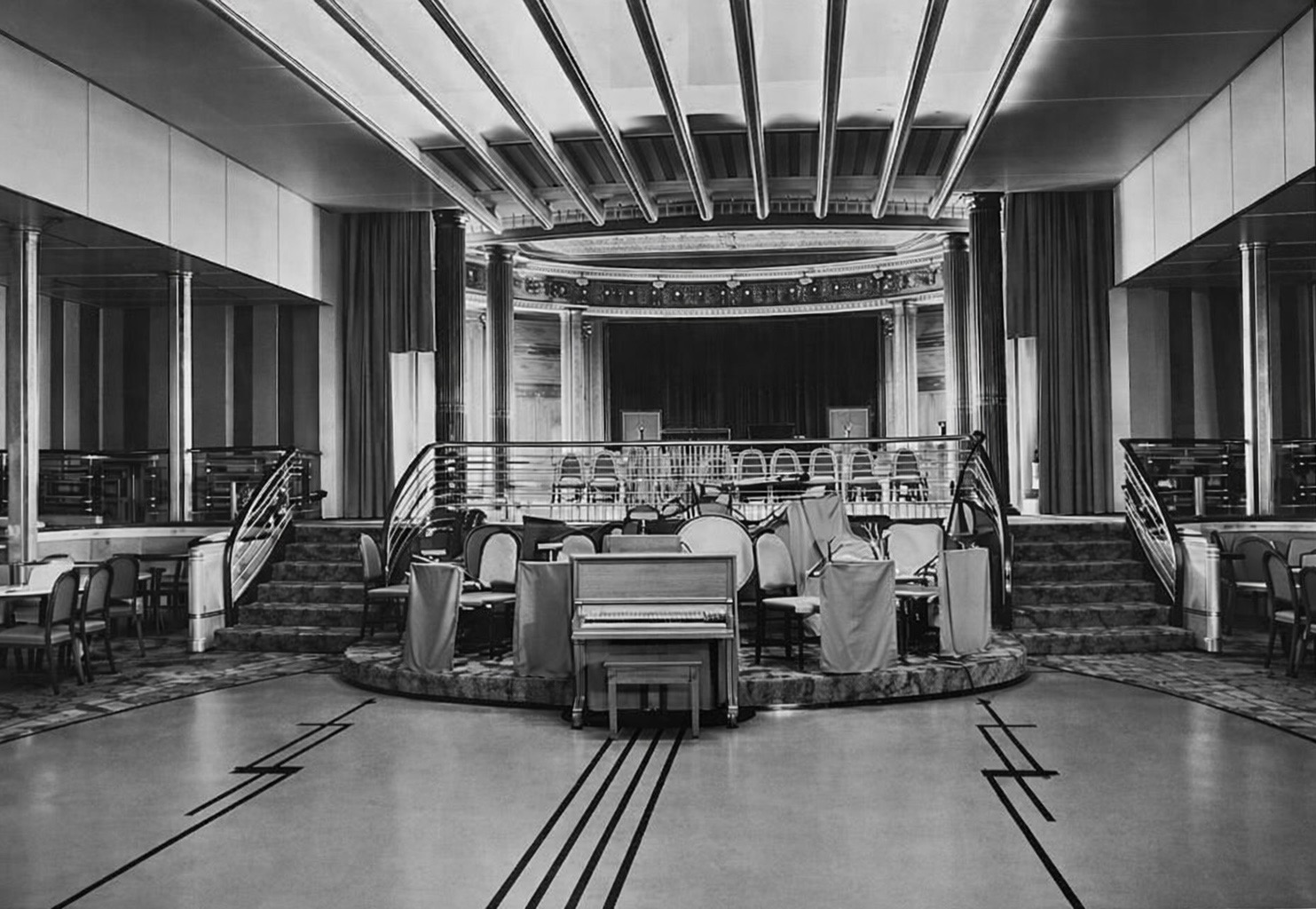
Night Club
Late-life reinventionIn the later years, the night club was one of the clearest signs that Leviathan was not a static interior world frozen at the moment of her launch or early service. By the time this space emerged—replacing earlier arrangements associated with the Winter Garden and the Ritz-Carlton Restaurant—the ship was operating in a different cultural moment. Passenger expectations had shifted, and so had the competitive landscape of transatlantic travel.
Where earlier interiors emphasized dining formality, garden-like leisure, or hotel-inspired refinement, the night club pointed toward a more explicitly entertainment-focused model of shipboard life. Dancing, music, and evening spectacle became central rather than supplementary. The room therefore signals a transition: from a world organized primarily around ritualized meals and structured sociability to one that placed greater emphasis on experience, atmosphere, and nightlife.
This change is interpretively important because it shows Leviathan adapting rather than simply declining. Even as newer liners appeared, the ship’s interiors were being reworked to remain relevant. The night club stands as evidence that large liners could be reprogrammed, reshaped, and repositioned in response to evolving tastes rather than abandoned to their original design logic.
- Shows Leviathan’s interiors changing over time rather than remaining fixed.
- Marks a shift toward entertainment and nightlife as central shipboard experiences.
- Helps connect the ship to broader cultural changes in interwar leisure and travel.
Comparison table: why these rooms matter
| Room | Best remembered for | Type of significance | Why it endures |
|---|---|---|---|
| Main Dining Saloon | Scale, ritual, and organized luxury | Operational and ceremonial | It shows how Leviathan turned giant size into a usable passenger experience. |
| Entrance Hall / Grand Hall | Arrival and first impression | Architectural and interpretive | It framed how passengers first understood the ship’s interior ambition. |
| First-Class Lounge | Refined sociability | Atmospheric and social | It reveals luxury in a quieter and more livable mode. |
| Smoking Room | Club character and masculine ritual | Mood and social identity | It captures one of the clearest social types in liner design. |
| Palm Garden / Café Spaces | Fashionable informality | Stylistic and experiential | They softened the ship’s scale and broadened the emotional range of the interiors. |
| Ritz-Carlton Room | Selective dining and fashionable atmosphere | Social and stylistic differentiation | It shows Leviathan offering layered luxury beyond the scale of the main saloon. |
| Swimming Pool | Modern recreation and amenity culture | Lifestyle and hospitality significance | It shows Leviathan as a ship offering a fuller luxury environment, not only formal interiors. |
| Tourist or Cabin-Class Rooms | The wider passenger world | Interpretive balance | They prevent the story from becoming only one of first-class grandeur. |
| Later Years Night Club | Entertainment, dancing, and nightlife | Adaptive and chronological significance | It shows Leviathan evolving in response to changing passenger expectations. |
Why Leviathan’s interiors still matter
Leviathan’s public rooms remain valuable because they help recover the ship as an environment rather than only an engineering statistic or a famous name. They show how one of the interwar Atlantic’s great superliners organized prestige, nationality, class, and leisure into a coherent passenger world. They also illuminate a more complicated story than a purpose-built liner with an uninterrupted identity would provide. Leviathan’s interiors carry the afterlife of Vaterland within them, which makes them especially revealing for anyone interested in continuity, redesign, and historical reinterpretation at sea.
Frequently asked questions
⟡ Was Leviathan known for one single overwhelmingly famous room?
⟡ Not quite in the way Titanic is often reduced to the Grand Staircase. Leviathan is usually better understood through a group of major interiors rather than one singular iconic room.
⟡ Why does the dining saloon matter so much?
⟡ Because it makes Leviathan’s scale visible in practical terms. It shows the ship as a working luxury environment, not just an object of prestige.
⟡ Why include quieter rooms like reading or writing rooms?
⟡ Because liner luxury depended on atmosphere and routine as much as spectacle. Smaller rooms made the ship feel inhabitable.
⟡ Did Leviathan’s earlier life as Vaterland matter to her interiors?
⟡ Yes. It matters interpretively because the ship’s public rooms existed within a story of inheritance, alteration, and American re-presentation rather than a completely static decorative identity.
⟡ Why mention non-first-class rooms at all?
⟡ Because Leviathan’s interior history becomes more convincing when it reflects the broader passenger structure of the ship rather than only the most glamorous promotional spaces.
Continue Exploring Leviathan
SS Leviathan topic hub
Start from a central overview of pages, themes, and research paths tied to Leviathan.
TransformationFrom Vaterland to Leviathan
Follow the ship’s transition in identity, service, and presentation.
Ship guideSS Leviathan ship guide
Read a broader curator-minded overview of the ship’s career and significance.
ExploreMore ocean liner interiors
Continue into other ship guides, collections, and interior-history pages across the site.
Sources & standards
This page emphasizes public rooms that help explain Leviathan as a passenger environment rather than only as a famous giant liner. The language stays strongest where the general significance of a room type is well established, and more careful where a room’s exact remembered status depends on changing decoration, evolving ship identity, or later interpretation.