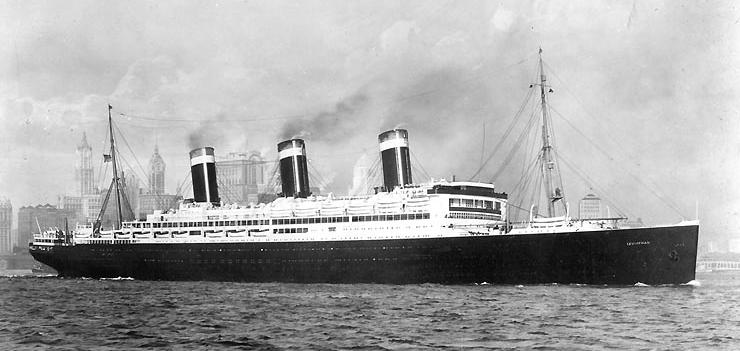

SS Leviathan
United States Lines · 1923–1934 (passenger career; intermittent late sailings) · Ship Guide
Overview
SS Leviathan was the American identity of the German Hamburg America Line giant Vaterland. Launched at Hamburg on 13 April 1913—not 3 April, as the previous guide stated—she entered German passenger service in 1914, was immobilized at Hoboken after the outbreak of war, seized by the United States in 1917, and transformed into one of the most important American troop transports of the First World War.
Reconditioned for civilian service after the war, she became the flagship-scale centerpiece of United States Lines in 1923. Her later career was commercially difficult, but the chronology is now clear: she was sold for scrapping in December 1937 and broken up at Rosyth in 1938, not after the Second World War.
Key Facts
Vaterland Before the War
Vaterland was one of Hamburg America Line’s huge prewar Imperator-class liners, designed to compete through size, spectacle, and high-capacity service rather than through a narrow pursuit of the fastest crossing. Her German passenger career was extremely brief. War in Europe trapped the ship at Hoboken in 1914 after only a handful of Atlantic voyages.
This short German phase is still critical for attribution. HAPAG menus, brochures, postcards, china, and interior images belong to Vaterland, not to the later American passenger liner even when the physical spaces can be traced through refits.
Seizure and USS Leviathan
The United States seized the ship on 6 April 1917. After repair and conversion she entered Navy service and was formally renamed USS Leviathan on 6 September. Naval History and Heritage Command records ten round trips before the Armistice and more than 119,000 fighting men carried eastward to Europe.
After 11 November 1918 the traffic reversed. Leviathan made nine westbound repatriation crossings, returning veterans to the United States before her final naval voyage ended in September 1919. She was decommissioned on 29 October and returned to the U.S. Shipping Board.
The 1923 American Rebirth
Transforming the former German liner back into a first-class passenger ship required extensive work. The reconditioning was completed in June 1923, after which the Shipping Board placed the vessel with United States Lines. Contemporary photographs show the ship in Boston Navy Yard drydock that July, while surviving NHHC voyage material documents her early American passenger crossings.
The new Leviathan was intended to embody an American merchant-marine presence on the North Atlantic. Her scale made her a publicity asset, but it also made her costly to operate. The economics of a huge prewar hull, Prohibition-era passenger service, international competition, and later Depression conditions never matched the symbolism attached to the ship.
Passenger Service and Public Image
United States Lines promoted Leviathan as an American flagship, and her interiors, menus, passenger lists, advertisements, and voyage cards created a documentary identity quite separate from both HAPAG Vaterland and USS Leviathan. An NHHC voyage card, for example, records an eastbound New York–Cherbourg passage from 29 September to 5 October 1923.
The ship also remained very much an Atlantic vessel in operational terms. NHHC preserves a bridge-view photograph from October 1923 showing heavy weather and green water over the bow, a useful corrective to interpretations that focus only on interiors and prestige.
Decline and Disposal
By the 1930s the economics had become increasingly unfavorable. Leviathan spent substantial periods inactive and never achieved the stable profitability hoped for when she returned to service.
Her end is often misstated. NHHC records that she was sold to a British scrapping firm on 10 December 1937 and broken up at Rosyth in 1938. She therefore did not survive into or through the Second World War as an intact ship.
Why Leviathan Matters
Leviathan matters because one hull became a German imperial prestige liner, a mass American troop transport, and an interwar U.S. commercial flagship. Each identity was politically and visually powerful in its own context.
For cataloging, the names are historical boundaries rather than synonyms. HAPAG Vaterland, USS Leviathan, and United States Lines SS Leviathan should be described separately even when an object’s physical provenance ultimately leads back to the same ship.
Evidence-first ship guideSources (Selected)