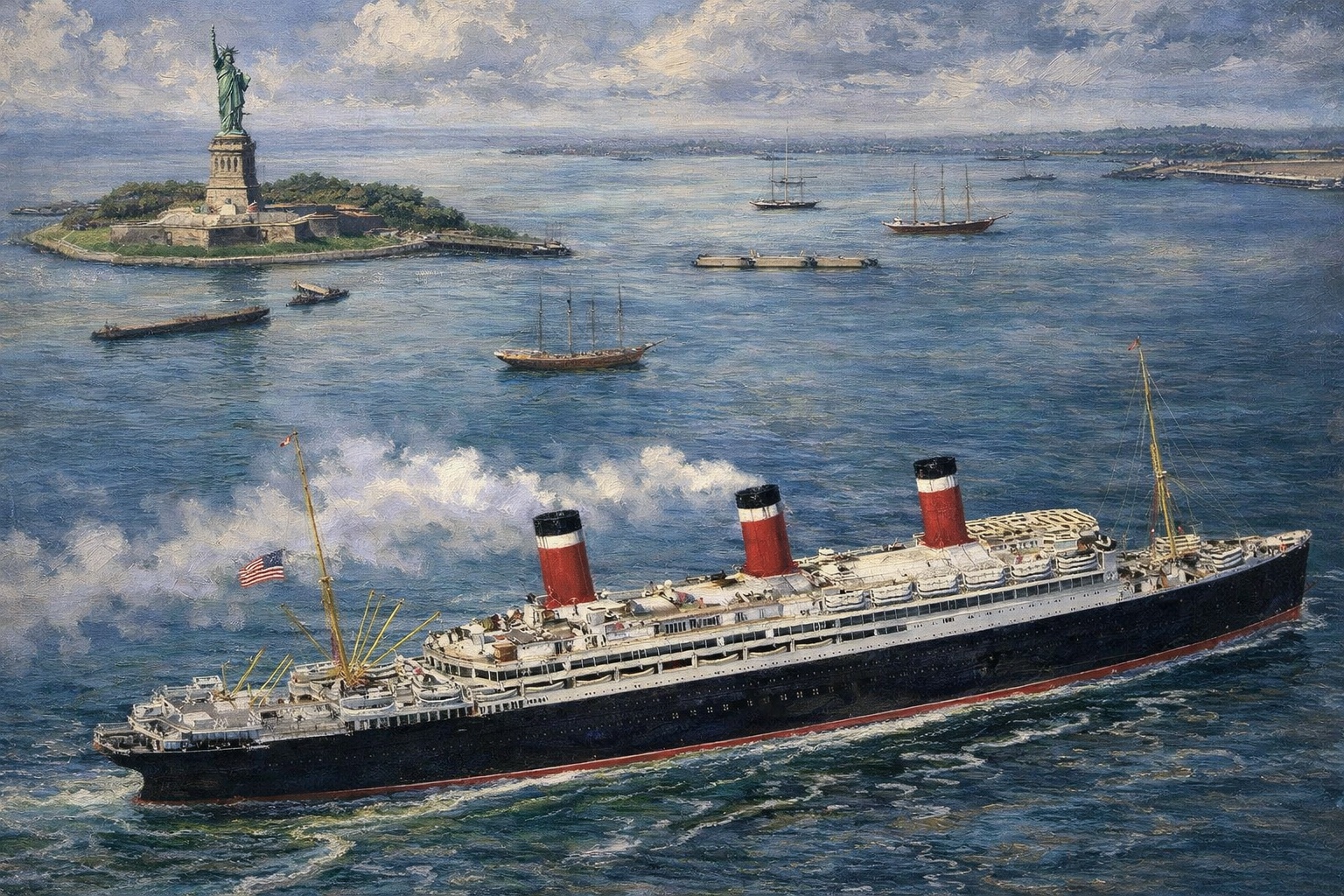
SS Leviathan — Specifications, Scale, and Comparison
A factual grounding page for one of the great giant liners of the early twentieth century: her size, principal dimensions, passenger capacity, and how she compared with some of the other major ships that framed her era.
The aim here is not just to list numbers, but to explain what those numbers did—and did not—mean in practical and historical terms.

Scale needs context
Leviathan was unquestionably immense, but tonnage, length, speed, and capacity do not all describe the same thing. This page treats those measures carefully rather than using them as interchangeable shorthand.
Principal specifications
These are the figures most readers look for first. Exact published numbers can vary slightly from source to source depending on date, measuring convention, or whether the ship is being discussed in her German or American career.
Original name
SS Vaterland
Operator in American career
United States Lines
Gross tonnage
About 59,900 GRT
Length
About 950 feet
Beam
About 100 feet
Service speed
Roughly 23 knots
Passenger capacity
Over 4,000 passengers
Builder
Blohm & Voss, Hamburg
Figures on ships like Leviathan are often repeated with more precision than the surviving context warrants. For practical reading, approximate figures are usually more honest than false exactness.
What those numbers actually mean
One of the easiest mistakes in ocean liner history is to treat every impressive number as though it describes the same quality. It does not. Gross tonnage is not a simple synonym for physical length, and neither tonnage nor length automatically tells us how refined, comfortable, or commercially successful a ship was.
In Leviathan’s case, the figures do confirm something important: she was genuinely one of the great large liners of her day. That part is not myth. But those figures alone do not settle questions about atmosphere, service reputation, or whether she was judged equal in finish or prestige to every rival she stood beside.
This is one reason Leviathan benefits from a two-part reading. First, she can be appreciated as an engineering and commercial presence of great size. Second, she has to be understood as a ship whose historical meaning depended on more than just measurements—especially once her American service, public image, and comparisons with rival liners are taken into account.
How Leviathan compared
Comparison is where raw specifications become more useful. The table below is not meant to flatten these ships into a single ranking, but to give a sense of how Leviathan sat within the larger field of famous North Atlantic liners.
| Ship | Approx. gross tonnage | Approx. length | Approx. service speed | General context |
|---|---|---|---|---|
| SS Leviathan | ~59,900 GRT | ~950 ft | ~23 knots | A giant liner whose scale was central to both her reputation and her symbolic value in American service. |
| RMS Olympic | ~45,000 GRT | ~882 ft | ~21–22 knots | Smaller than Leviathan by gross tonnage, but often remembered for steadiness, career length, and balanced success. |
| RMS Titanic | ~46,000 GRT | ~882 ft | ~21–22 knots | Famous beyond proportion to career length; often serves as a public reference point even when other liners surpassed her in size. |
| RMS Majestic | ~56,500 GRT | ~956 ft | ~23 knots | Another giant ex-German liner, close to Leviathan in the discussion of interwar scale and prestige. |
| RMS Queen Mary | ~81,000 GRT | ~1,019 ft | ~28+ knots | A later and faster generation of giant liner, useful as a reminder that size leadership did not stand still. |
Comparison tables are useful, but they should not be mistaken for verdicts. A ship could be larger without being more admired in every respect, and a ship could be slower without being historically less important.
Scale in historical context
Immense by any fair standard
Leviathan really was a giant ship by the standards of the early twentieth century. Discussions of her size are not just retrospective exaggeration; they reflect something observers at the time would have felt immediately.
Not every measure means “best”
The temptation is always to turn size into a verdict. But scale does not automatically tell us which ship was judged finest, most successful, or most beloved in service.
A bridge between eras
Leviathan belongs to a moment when liner history was shifting. She carried the grandeur of prewar gigantism forward into a different national and commercial setting, which is part of what makes her so interesting.
From Vaterland to Leviathan
One of the most important things about Leviathan’s specifications is that they connect two lives of the same ship. Her later American identity is often so visually and culturally dominant that it can obscure the degree to which the ship’s size and basic physical presence originated in her German conception as Vaterland.
That continuity matters. It reminds us that the ship’s dimensions were not invented anew when her public image changed. What changed more dramatically was the interpretive frame around the ship: her national symbolism, her internal presentation, and the way she was positioned in public memory.
This is one reason Leviathan repays comparison with herself across time. Her specifications help anchor the discussion, while her fitted identity, service atmosphere, and cultural meaning shifted around them.
What the evidence supports — and what it does not
Basic figures for a ship like Leviathan are generally better documented than many of the claims people build on top of them. It is usually much easier to establish approximate tonnage, length, and speed than to settle broader judgments about whether a ship was superior in comfort, refinement, atmosphere, or service culture.
That distinction is worth holding onto. The record supports calling Leviathan one of the largest and most physically imposing liners of her era. It does not require us to turn every measure of scale into a universal claim of dominance. In other words, the numbers are real; the larger conclusions still need interpretation.
For Ocean Liner Curator, that is the right balance: take the measurable scale seriously, then keep a little discipline when moving from measurement to mythology.
Claims about “largest,” “greatest,” or “best” often hide multiple criteria inside one word. This page is meant to keep those criteria visible rather than collapsing them into a single label.
Go deeper into Leviathan
This page works best as a reference anchor. The fuller picture comes from pairing it with the interpretive, visual, and collecting pages that surround it.