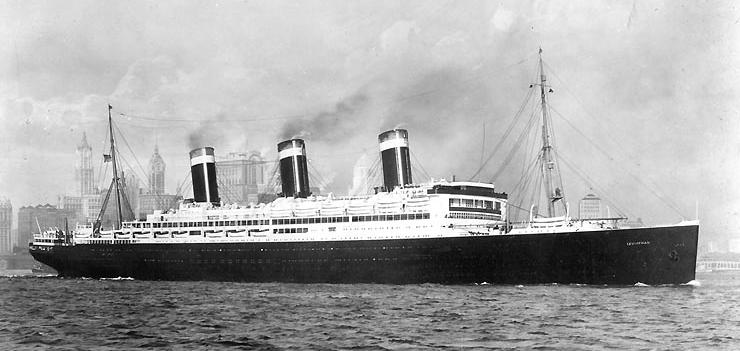
Vaterland as Prestige
Built for Hamburg America, Vaterland embodied prewar scale, confidence, and German Atlantic ambition. Her size and appointments mattered not only commercially, but symbolically.
A curator-minded path through one of the Atlantic world’s most dramatic liner transformations: from the German giant Vaterland, through internment and wartime seizure, to troopship service and eventual reintroduction as the American liner Leviathan.
Research Collections group ship guides and interpretive themes into curator-framed pathways that emphasize shared structures, turning points, and larger historical meanings. This collection follows not simply a ship with two names, but a vessel whose political identity, practical function, and public meaning were all radically recast by war.
Vaterland began as a Hamburg America prestige liner: immense, modern, and unmistakably bound to German commercial and symbolic ambition. Yet the First World War interrupted that career almost at once. Interned in Hoboken, later seized by the United States, repaired, renamed, and deployed as a troopship, the vessel that re-emerged as Leviathan had crossed more than an ocean. It had crossed regimes, purposes, and historical frames.
Built for Hamburg America, Vaterland embodied prewar scale, confidence, and German Atlantic ambition. Her size and appointments mattered not only commercially, but symbolically.
Internment froze the ship’s original career. American seizure in 1917 turned her from foreign asset into wartime instrument, while damage found aboard underscored how abrupt and contested that transition had been.
Under American control the ship became more than a captured liner. As Leviathan, she served first as transport, then later as a high-profile passenger liner whose identity had to be rebuilt for a new public.
Built for the Hamburg America Line, Vaterland entered the Atlantic world as one of the largest liners of her time. She belonged to the prewar language of scale, prestige, and national commercial competition.
With the outbreak of the First World War, the ship found herself unable to continue her intended service pattern. Rather than sustaining a normal commercial career, she became an immobilized giant in an altered political world.
Held at Hoboken while the United States remained neutral, Vaterland existed in an unusual state: physically intact, highly visible, and yet suspended between ownership and usefulness. Her very scale made that suspension striking.
Once the United States entered the war, Vaterland was seized along with other German vessels in American ports. The act was practical and political at once: an enormous liner became available for American wartime needs.
The ship reportedly required major repair work after seizure, with machinery and fittings found damaged. That matters historically because it reminds us the handover was not a frictionless administrative event, but a contested break.
Renaming the ship Leviathan was more than a label change. It recast public identity. A vessel born in one national and corporate setting was now being presented as part of a very different wartime story.
In military service, Leviathan became one of the most important transport vessels in the American war effort. Luxury mattered less than capacity, reliability, and the ability to move vast numbers of personnel across the Atlantic.
Once wartime necessity ended, the question shifted. How could an ex-German liner, already reshaped by military service, be made marketable again as a civilian flagship under American operation? The answer required refit, reinterpretation, and presentation.
Rebuilt for civilian use, Leviathan returned to the Atlantic as an American liner. Yet the ship’s significance now lay partly in that layered history: German origin, wartime seizure, troopship conversion, and peacetime reinvention.
One productive way to read this story is to see Vaterland as the prestige liner, internment as the pause, seizure as the rupture, and Leviathan as the vessel rebuilt from that interruption into a new public role.
The physical ship survived, but the meaning attached to it changed dramatically. Few liners show more clearly how war can separate a vessel from its founding national story.
Leviathan illustrates how quickly prestige tonnage could be repurposed in wartime, with capacity and transport value overtaking commercial glamour.
Postwar service was not a simple restoration. The ship had to be reintroduced to the traveling public in a different commercial, political, and cultural environment.
A useful companion for thinking about ships whose intended careers were altered or broken by war, disaster, or historical disruption.
Places Vaterland within the wider era of immense liners, prestige rivalry, and the symbolic value of size on the Atlantic.
Useful for situating Hamburg America, American operators, and the broader institutional setting in which the ship’s identity changed.
Helps place Vaterland and Leviathan within the larger chronology of transatlantic liners, war, and interwar passenger service.
Read Leviathan as a ship whose American life cannot be understood without the story of seizure, wartime adaptation, and postwar reconstruction.
Open ship guideUseful for placing Vaterland within the larger family of giant German liners built to project scale, modernity, and prestige before the war reshaped their meanings.
Open related context