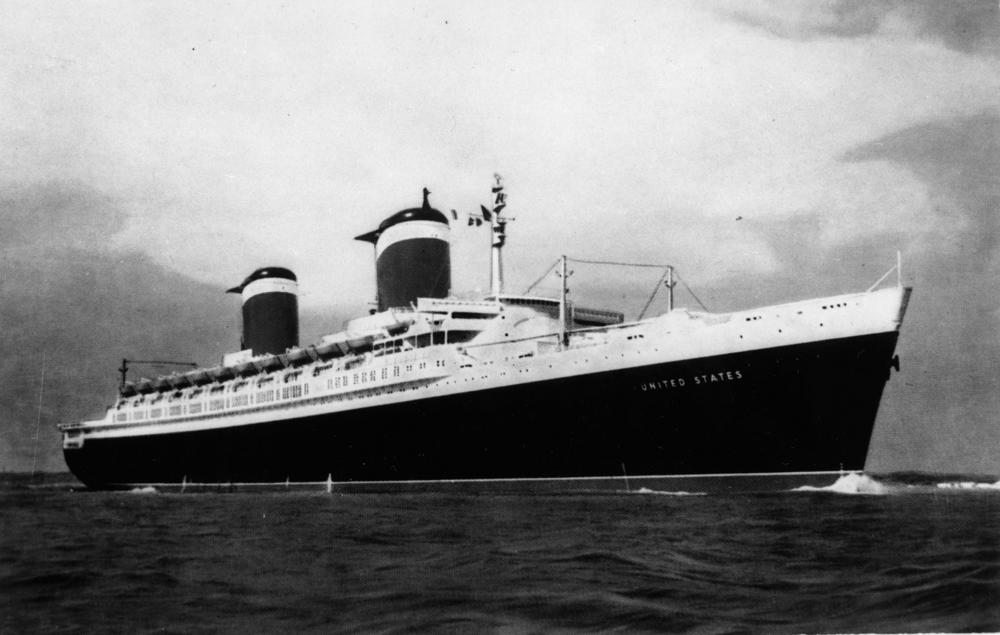
SS United States
United States Lines · entered service 1952 · Ship Guide
Overview
SS United States was the flagship of United States Lines and the most important American transatlantic liner of the postwar era. Designed under William Francis Gibbs and built at Newport News Shipbuilding, she combined commercial passenger service with documented national-defense requirements and set major Atlantic speed records on her first round voyage in July 1952.
Her second history has lasted much longer than her 17-year liner career. After withdrawal in 1969, the ship passed through repeated preservation and redevelopment proposals. In 2025 she left Philadelphia for Mobile, Alabama, after purchase by Okaloosa County, Florida, which intends to deploy the hull as an artificial reef and support a land-based museum.
Key Facts
Design and Defense Requirements
The U.S. Maritime Administration describes United States as a Maritime Commission design developed in partnership with United States Lines and the U.S. Navy. Passenger service was the primary role, but the ship was designed for rapid conversion to troop transport if required. Extensive aluminum construction reduced weight and limited the use of combustible interior materials.
That documented dual-purpose requirement is enough to explain much of the ship's unusual engineering. It is not necessary to rely on later folklore about “secret warship” characteristics when government records already establish the underlying defense context.
1952 Atlantic Records
The ship departed New York on 3 July 1952 and captured the eastbound Blue Riband on her maiden voyage. U.S. Coast Guard period reporting records a westbound record on the return passage as well. The records established the ship immediately as the fastest passenger liner of her era and became central to her public identity.
Speed claims should still be stated carefully. “Fastest ocean liner” can refer to different measured passages, average speeds, or later challenge criteria. The 1952 Atlantic crossing records are the secure historical core.
Seventeen Years in Service
United States remained in scheduled transatlantic service through the 1950s and 1960s, carrying celebrities, government figures, tourists, and ordinary passengers while jet aviation steadily eroded the market. United States Lines withdrew the ship in November 1969. She never returned to commercial passenger service.
Preservation and Artificial-Reef Plan
For decades after retirement, owners and preservation advocates proposed hotel, museum, cruise, and mixed-use conversions. The SS United States Conservancy ultimately maintained the ship at Philadelphia until a berth dispute and rising costs made continued occupation untenable. Okaloosa County purchased the vessel in 2024 for an artificial-reef project, and the ship left Philadelphia in late February 2025 for Mobile.
September 2026 update: Okaloosa County states that required environmental remediation is complete. The county is awaiting final approvals from the U.S. Army Corps of Engineers and the Environmental Protection Agency before a deployment date can be set. Accordingly, the earlier “early 2026” target is obsolete; there is currently no confirmed sinking date.
The county plans deployment in Gulf waters off Destin–Fort Walton Beach and has also committed to supporting a land-based museum. The Conservancy states that significant components, including the stacks and mast, have been reserved for museum use.
Interpretive Note
The ship's preservation story is still active history. Claims about a future deployment date, exact reef position, museum opening, or final configuration should be dated and sourced to current county or Conservancy material rather than copied from older news reports.
Evidence-first ship guideSources (Selected)
- Ocean Liner Curator — Sources (master bibliography)
- U.S. Maritime Administration — SS United States
- U.S. Coast Guard — period account of the 1952 record voyages
- Okaloosa County — SS United States project FAQ and current deployment status
- SS United States Conservancy — current ship location and reef-project FAQ