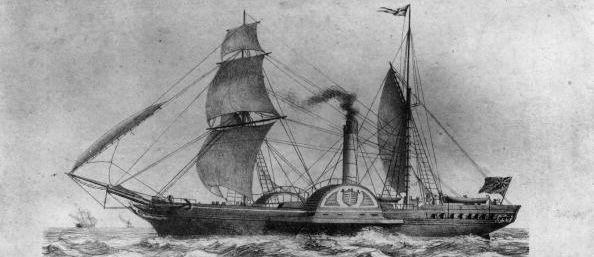
SS Sirius
Saint George Steam Packet Company · 1837 · Ship Guide
Overview
SS Sirius was a wooden-hulled paddle steamer built for the Saint George Steam Packet Company and originally intended for service between Cork and London. She became historically important in 1838 when, after being chartered for a special venture, she completed the first transatlantic passenger crossing performed entirely under steam power.
In collecting and interpretation, Sirius is especially important because she stands at the threshold between coastal / packet steam service and the true ocean-liner era. She was not a purpose-built giant Atlantic liner in the later sense, yet her 1838 voyage is one of the foundation events in transatlantic steam-passenger history.
Key Facts
Early steamship measurements can appear in several different systems, and “first Atlantic steam crossing” language is sometimes phrased differently depending on whether a source is emphasizing passenger service, continuous steam power, or vessels specially designed for the crossing. For curator-level precision, it helps to preserve the exact wording used by the source being cited.
Design & Construction Context
Sirius was not originally built as a dedicated Atlantic liner on the scale of later 19th-century ocean steamers. She was designed for the more limited but still prestigious Cork–London service, and in that role she was already a substantial and modern packet for her operator.
What makes her historically exceptional is that she was adapted and chartered into a new kind of experiment: proving that a steamship could carry passengers across the Atlantic without reverting to sail as the primary means of propulsion. In that sense, Sirius belongs to the threshold moment when coastal and packet steam technology was being pushed into oceanic service before purpose-built Atlantic steamers fully took over.
Service History (Summary)
1837: Entered service for the Saint George Steam Packet Company on the Cork–London route. This is the ship’s original operating context and should not be forgotten beneath the fame of the 1838 Atlantic voyage.
1838 Atlantic crossing: Chartered by the British and American Steam Navigation Company when that firm’s intended purpose-built ship was delayed. Sirius sailed from London, called at Cork for passengers and coal, and departed Cork on April 4, 1838, reaching New York on 22 April.
Fuel-shortage legend: the voyage is famous for the story that, running low on coal near the end, combustible materials including spare spars, resin, and furniture were fed to the furnaces rather than hoisting sail in the conventional sense. This anecdote is deeply embedded in the ship’s memory and helps explain why the crossing became legendary even though Great Western soon overshadowed her in commercial scale.
After 1838: Returned to more ordinary packet and coastal service. Like many pioneering vessels, she is remembered mainly for the breakthrough voyage, but most of her working life was less spectacular.
1847: Wrecked off Ballycotton, County Cork. Her loss ended a comparatively short but historically foundational career.
The 1838 Crossing in Precise Context
Sirius left London on 28 March 1838, called at Cork, and departed Cork on 4 April. She reached New York on 22 April, only hours before Brunel’s purpose-built Great Western. That sequence explains both her fame and the need for careful wording: Sirius demonstrated continuous steam passenger passage across the Atlantic, while Great Western represented the more scalable purpose-built commercial model.
The later “Blue Riband” language is retrospective. The term itself belongs to a later period, so it is safest to describe Sirius as an early speed-record holder only when the retrospective nature of the label is made clear.
The 1847 Wreck
On 16 January 1847, while bound for Cork from Glasgow via Dublin, Sirius struck rocks in dense fog in Ballycotton Bay. She was refloated but remained badly damaged and ultimately wrecked on Smith’s Rocks. Twenty people died and 71 survived.
The casualty later contributed to renewed attention to lighthouse provision on Ireland’s southern coast. For curatorial purposes, wreck material, rescue accounts, and later commemorative imagery should be distinguished from evidence tied directly to the 1838 transatlantic voyage.
Why Sirius Matters
Sirius matters because she sits exactly at the boundary between coastal steam packets and the mature ocean liner. Her historic voyage was an improvised commercial experiment carried out by a ship built for another route, yet it helped prove that passengers could cross the Atlantic under sustained steam power.
Interpretive Notes
She was a pioneer, not a classic later “liner” in full maturity: Sirius should be understood as an early steam packet pushed into Atlantic service at a formative moment, not as a purpose-built express liner in the later mold of Great Western or post-1850 transatlantic ships.
The “first” claim needs careful phrasing: many summaries call her the first steamship to cross the Atlantic, but better curator practice is to specify that she was the first to complete a transatlantic passenger crossing under continuous steam power. That preserves the achievement while avoiding flattening earlier and parallel experiments.
Great Western context matters: Sirius and Great Western reached New York on the same historic April 1838 occasion, but they represent slightly different things: Sirius as the improvised pioneer and Great Western as the first major steamer purpose-built for the Atlantic trade.
Artifacts may be very scarce and often retrospective: because this is such an early ship, much surviving visual or printed material may be later commemorative imagery rather than routine onboard ephemera of the type more familiar from later liners. Attribution should therefore be handled with particular caution.
Evidence-first ship guideSources (Selected)
- Ocean Liner Curator — Sources (master bibliography)
- SS Sirius (1837) — overview, chronology, and bibliography
- MaritimeQuest — Sirius builder’s data and voyage chronology
- Britannica — Sirius summary
- Transportation History — 1838 Atlantic crossing context
- Jeanie Johnston — early Atlantic steamship context