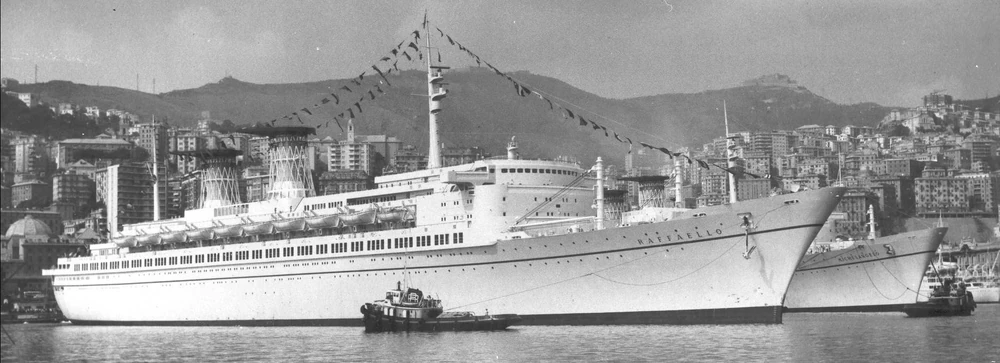
SS Raffaello (1965)
Italian Line · 1965 · Ship Guide
Overview
SS Raffaello entered service in 1965 as the second of Italian Line’s final great transatlantic pair. Built at CRDA’s San Marco yard at Monfalcone, she was launched on 24 March 1963 and completed in 1965 for a market already being transformed by jet aviation.
Her career divides into three clear phases: Italian Line liner/cruise service through 1975, static accommodation in Iran from the late 1970s, and wreck status after being hit during the Iran–Iraq War in 1983.
Key Facts
The Second of Italy’s Final Pair
Raffaello and Michelangelo were conceived as a matched statement of national industrial and design capability. Their basic dimensions, machinery power, and passenger arrangements were closely related, but their interiors and operational reputations were not identical.
Raffaello is often overshadowed by her sister in later narratives. That makes ship-specific evidence especially important when attributing photographs or interiors rather than treating the pair as interchangeable.
Vibration and Early Modifications
Specialist histories record significant vibration during early high-speed operation. Modifications to propellers and transmission components were undertaken after trials and early running, reducing the problem.
This is a useful reminder that “as completed” and “as operated after initial correction” can represent different technical states even within the first season of a new liner.
Transatlantic Service and Cruising
Raffaello entered line service on 25 July 1965 after an inaugural cruise earlier that month. As air travel continued to reduce demand for scheduled sea passage, Italian Line increasingly used her for cruise work.
She was not ideally configured for the emerging cruise market. Her three-class layout, cabin mix, and high operating costs made adaptation difficult, even though she had substantial open deck space and strong visual appeal.
Withdrawal and Sale to Iran
The Italian Line withdrew Raffaello in June 1975 as state support for the remaining prestige liners became politically and economically unsustainable. She was laid up in Italy while potential buyers considered conversion schemes.
Iran ultimately acquired both sisters for static accommodation. Proposed plans to return them to luxury cruise service never came to fruition, in part because deterioration made reconstruction increasingly expensive.
The 1983 Wreck
During the Iran–Iraq War, Raffaello was hit in 1983 and partially sank in shallow water near Bushehr. Later accounts describe additional damage and looting. The wreck remains a separate evidentiary phase from both Italian Line service and the earlier Iranian accommodation period.
Modern photographs of the wreck should therefore never be used as generic illustrations of the ship’s active passenger-service condition.
Collecting and Attribution Notes
Raffaello material is easiest to date when itinerary, class, and printer information survive together. Menus, passenger lists, sailing folders, postcards, and onboard stationery can usually be assigned to a specific operating phase, but generic Italian Line branding is not enough to distinguish her from Michelangelo.
Iran-era photographs require even more caution. Later retellings often compress sale, tow, accommodation use, revolutionary damage, and the 1983 missile strike into one vague “abandoned at Bushehr” story. A strong catalog record should separate what is visible in the object from what is reconstructed through later history.
Service Evidence and Sister-Ship Caution
Because Raffaello and Michelangelo shared broadly similar dimensions and a highly recognizable paired-funnel appearance, undated photographs are sometimes misidentified between the sisters. Interior evidence is even more vulnerable to this problem because later retrospectives often illustrate one ship while discussing the pair together.
For curatorial attribution, ship name printed on the object, voyage date, port sequence, interior-room name, and image credit should take precedence over a generic “Italian Line twins” caption. That discipline is especially important for brochures and decorative material whose visual style was intentionally coordinated across both flagships.
Why Raffaello Matters
Raffaello illustrates the commercial problem facing the last generation of purpose-built liners: technical excellence and national prestige could not compensate for a transportation market moving decisively toward aviation.
Her archive is clearest when divided into Italian Line service, post-withdrawal lay-up, Iranian static use, and the 1983 wreck. That phase separation is especially important because later retellings often compress those events into a vague “sold to Iran and sunk” ending.
Evidence-first ship guideSources (Selected)