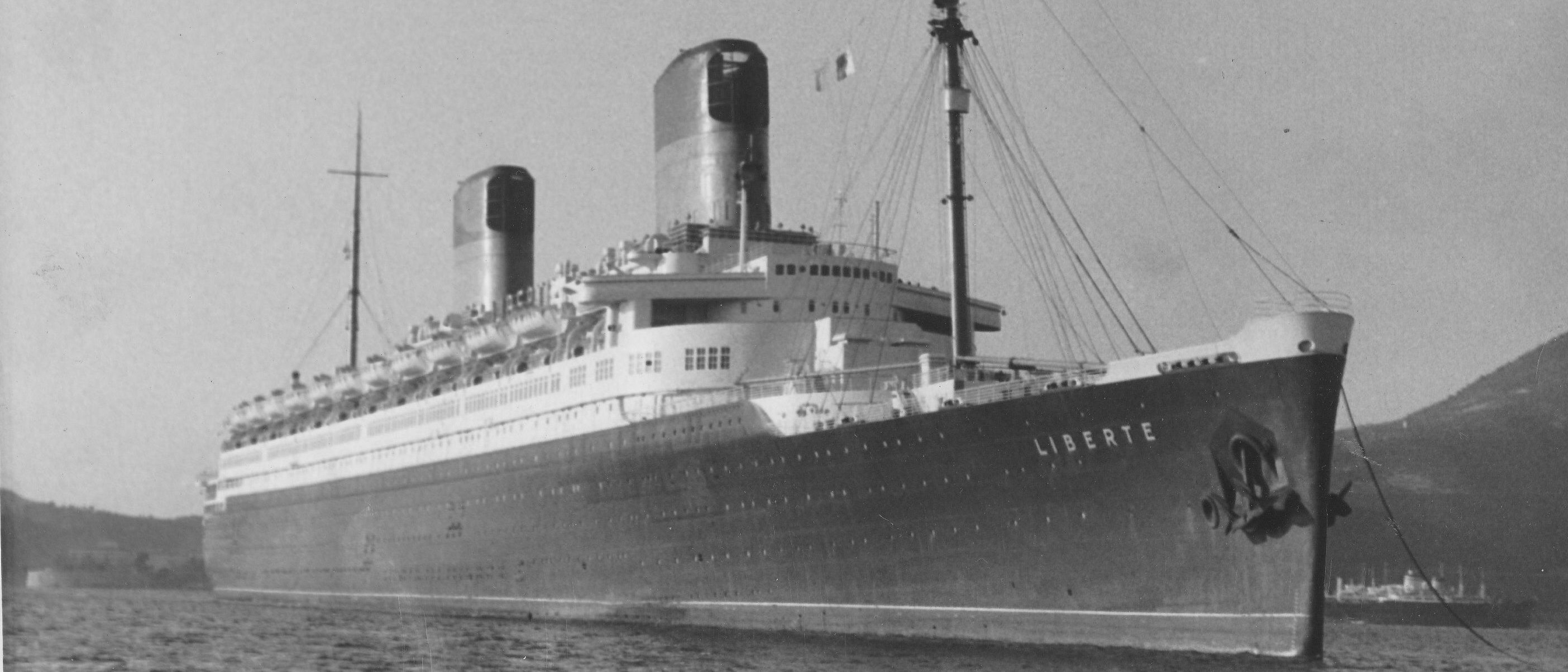
SS Liberté
Compagnie Générale Transatlantique · 1950 · Ship Guide
Overview
SS Liberté was the postwar French flagship created from the former German liner Europa. Originally built for Norddeutscher Lloyd and launched in 1928, she entered French Line service only after the Second World War, extensive rebuilding, and multiple accidents during refit. In French service she became one of the most visually and symbolically important transatlantic liners of the early 1950s.
In collecting and interpretation, Liberté is especially important because she is both a French postwar icon and an ex-German superliner with a long earlier life as Europa. Catalog records should preserve the name and career phase actually represented on the artifact rather than merging all periods too casually.
Key Facts
Tonnage, passenger totals, and even the precise maiden-voyage date can appear slightly differently across quick summaries because sources sometimes compress the final refit period. For museum-level precision, it helps to preserve the exact figure and wording used by the source being cited.
Design & Construction Context
Liberté cannot be understood without first recognizing that she was born as Europa, one of the great German speed queens of the interwar Atlantic. Designed alongside Bremen, she represented the most advanced transatlantic turbine-liner technology of her day and was built for high-speed service on the North Atlantic.
Her later French identity transformed that earlier German achievement into a postwar French flagship. In this sense, Liberté is not simply “a French liner,” but a rebuilt and recontextualized Atlantic prestige ship whose meaning changed dramatically after 1945. That layered identity is part of what makes her so compelling historically and visually.
Service History (Summary)
1928–1945 (as Europa): Built for Norddeutscher Lloyd, launched in 1928, and entered German service in 1930. Her interwar career included Blue Riband-level speed prestige and major North Atlantic service, but that phase belongs to the ship’s pre-Liberté identity and should be cataloged separately.
1945–1946: Came under Allied control at the end of the war and was eventually assigned to France as compensation for the loss of Normandie.
1946–1950: Underwent a long and difficult rebuilding process. She suffered further accidents during this transition, including collision damage and fire, which delayed her re-entry into passenger service.
1950–1962: Served the French Line primarily on the Le Havre–Southampton–New York route as Liberté. In this period she became a centerpiece of French postwar transatlantic identity and one of the line’s best-known ships before the arrival of the new France.
1950s cultural presence: Liberté appeared in films and publicity imagery and became closely associated with glamorous postwar Atlantic travel. This matters for collectors because the ship generated a rich visual culture of menus, brochures, postcards, and promotional material distinct from her earlier German phase.
1962–1963: Withdrawn after the arrival of France, laid up, and then scrapped at La Spezia.
Europa Becomes Liberté
The French transformation of Europa into Liberté was more than a change of flag and name. The ship was received as postwar reparation tonnage and rebuilt to serve as a major French North Atlantic liner in a fleet still recovering from wartime losses, including the destruction of Normandie.
The 1946 Collision with Paris
On 8 December 1946, while still being prepared for French service at Le Havre, the former Europa broke her moorings during a violent storm and was driven onto the submerged wreck of the French liner Paris. The collision opened the hull aft and caused severe flooding.
The damage forced a major salvage and rebuilding effort at Saint-Nazaire. This episode is a crucial identity boundary: photographs from the immediate postwar transfer period document an unfinished French conversion, not the completed Liberté that passengers later knew.
French Redesign and the 1950 Debut
Contemporary French reporting described the rebuilt ship as extensively “Frenchified” in decoration and atmosphere. Le Monde recorded an official inauguration on 12 August 1950 and departure from Le Havre on 17 August for her first New York voyage as Liberté.
The result was a striking example of national reinterpretation of an existing hull: German engineering and basic spatial structure remained, while French designers reshaped the public rooms, furnishings, and decorative identity for a new postwar role.
Why Liberté Matters
Liberté shows how an ocean liner can acquire a genuinely new cultural identity without becoming a new ship. Her French career should be studied on its own terms while remaining firmly connected to the earlier Europa hull beneath it.
Interpretive Notes
Name discipline is essential: artifacts marked Europa and artifacts marked Liberté belong to very different national, political, and design contexts even though they concern the same hull.
She is a postwar replacement flagship: Liberté should often be interpreted in relation to the absence of Normandie. Her importance in French service is bound up with the need to restore prestige after wartime loss.
French style overlays German engineering: in collecting and interpretation, this ship is a useful case study in how a vessel’s symbolic identity can be radically recast without erasing its technical origins. The French public image of Liberté does not cancel the ship’s earlier life as Europa.
Do not overcompress the chronology: some brief summaries jump from “war prize” straight to “French service.” Curator practice should preserve the difficult 1946–1950 transition period, because it explains why Liberté entered service later than many casual accounts imply.
Evidence-first ship guideSources (Selected)
- Ocean Liner Curator — Sources (master bibliography)
- SS Europa / Liberté — overview and chronology
- Great Ships — Europa / Liberté context and image research aid
- The Great Ocean Liners — Europa / Liberté narrative context
- Cruise Line History — French Line Liberté context
- Le Monde, 9 August 1950 — contemporary account of Europa becoming Liberté