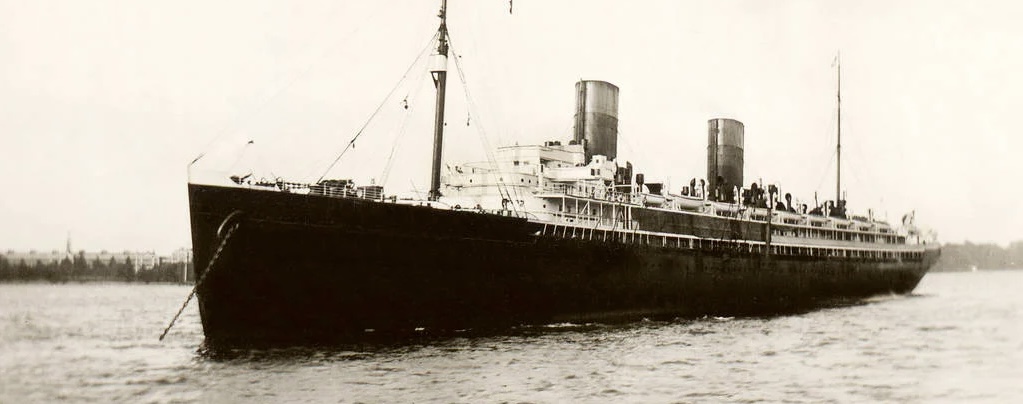
SS La Provence
Compagnie Générale Transatlantique · 1905 · Ship Guide
Overview
SS La Provence was a major French transatlantic liner built by Chantiers de Penhoët at Saint-Nazaire and launched in 1905. She was among the most ambitious French passenger liners of her moment, combining scale, speed, and highly visible national prestige on the Le Havre–New York route.
In collecting and interpretation, La Provence is especially useful because her story spans two quite different identities: first as a peacetime French express liner, then as the wartime troopship Provence II. Artifacts from those phases should be cataloged with close attention to printed name, date, and service context.
Key Facts
Some quick-reference sources differ on exact tonnage formatting and on whether they foreground the civilian name La Provence or the wartime designation Provence II. For curator-level precision, preserve the naming actually used by the source or printed artifact in hand.
Design & Construction Context
La Provence belongs to the pre-First World War generation of large national prestige liners in which speed, scale, and interior refinement all carried symbolic weight. She was not simply another mail steamer, but a statement that French shipbuilding and French transatlantic service could operate at a high competitive level on the North Atlantic.
That matters interpretively because French liners are sometimes compressed in English-language summaries into a few better-known names. La Provence helps widen the picture. She represents a French answer to the same prestige economy that produced major British and German Atlantic liners, while still reflecting the particular institutional and cultural world of the French Line.
Service History (Summary)
1906–1914: Served on the Le Havre–New York route for Compagnie Générale Transatlantique. This is the principal collecting era for menus, passenger lists, brochures, baggage labels, sailing cards, and other French Line material associated with La Provence.
Peacetime reputation: She was widely noted as one of the largest ships in the French merchant marine and one of the most important French-built liners of her day. In practical collecting terms, that means surviving ephemera can appear in both routine route-document form and more commemorative “prestige ship” form.
1914–1915: Requisitioned for wartime service and employed as an auxiliary cruiser and troopship. In this phase, the interpretive frame shifts sharply away from civilian passenger culture toward military transport and naval administration.
Final voyage, 1916: While sailing in the Mediterranean on a troop movement from Toulon toward Salonika, she was torpedoed by the German submarine U-35 near Cerigo on February 26, 1916. The sinking produced very heavy loss of life and became one of the major French maritime losses of the war.
Wartime Service in Detail
French naval memorial sources record that Provence II performed maritime surveillance south-east of Sicily in 1914 and made six troop-transport voyages toward the Dardanelles in 1915. By early 1916 she was being used to move large troop contingents between Toulon and the eastern Mediterranean.
On 23 February 1916 she left Toulon for Salonika with roughly 2,000 people aboard, many from the 372nd Infantry Regiment and 3rd Colonial Infantry Regiment. On 26 February, U-35 under Lothar von Arnauld de la Perière torpedoed the ship in the Aegean. French memorial accounts describe the vessel sinking in roughly fifteen minutes.
Casualty-Count Caution
The sinking produced catastrophic loss of life, but published totals vary depending on whether a source counts troops, naval personnel, crew, or all persons aboard. For museum-level writing, the date, submarine, route, and scale of the loss are secure; a precise casualty total should always be tied to the source that supplies it.
Why La Provence Matters
La Provence sits at the intersection of French national prestige and wartime mass transport. Her peacetime significance lies in the effort to build a first-rank French express liner; her wartime significance lies in how rapidly that same hull was absorbed into expeditionary logistics.
Interpretive Notes
Name discipline is essential: a peacetime menu, passenger list, or brochure belongs under La Provence, while wartime material may appear under Provence II. Those should not be merged casually in catalog records.
French Line context matters: items from La Provence should be interpreted within the CGT / French Line transatlantic framework, not simply folded into a generic “Atlantic liner” category without national context.
Prestige and routine coexisted: the ship was both a symbolically important French liner and a working route vessel. Surviving ephemera may therefore range from ceremonial or promotional material to quite ordinary operational documents.
Loss narratives should be handled carefully: casualty totals vary among brief summaries, and wartime accounts can compress the sequence too aggressively. Curator practice is to separate the well-documented basics of torpedoing, route, and date from any inflated or imprecise retellings.
Evidence-first ship guideSources (Selected)
- Ocean Liner Curator — Sources (master bibliography)
- SS La Provence — overview and chronology
- uboat.net — armed merchant cruiser / troopship La Provence loss record
- French shipping encyclopaedia / research context for major French liners
- Ships Nostalgia — research lead for published specifications
- Histomar — U-35 war diary context for the loss of Provence II