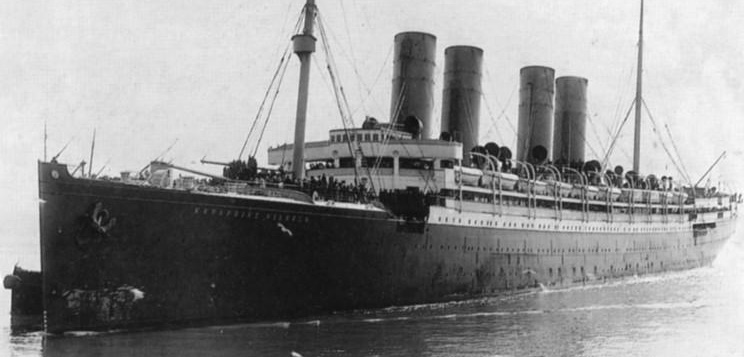
SS Kronprinz Wilhelm
Norddeutscher Lloyd · entered service 1901 · Ship Guide
Overview
SS Kronprinz Wilhelm was one of Norddeutscher Lloyd’s great four-funnel express liners of the early 20th century. Built at AG Vulcan in Stettin and launched in 1901, she belonged to the German high-speed Atlantic tradition that followed Kaiser Wilhelm der Grosse and helped define the image of the prewar “greyhound” liner.
In collecting and interpretation, Kronprinz Wilhelm is especially useful because her history divides neatly into several distinct phases: prestige German passenger liner, Blue Riband-era express steamer, wartime auxiliary cruiser, interned vessel in the United States, and later American transport. Artifacts from those phases should be cataloged by the printed name and service context actually represented.
Key Facts
Design & Construction Context
Kronprinz Wilhelm belonged to the generation of German superliners that transformed the visual language of the North Atlantic. With four funnels, a long black hull, and powerful reciprocating machinery, she projected speed, prestige, and national technological confidence. She was part of the same broad competitive moment that saw Germany challenge British supremacy in the Atlantic express trade.
That matters interpretively because ships like Kronprinz Wilhelm are often remembered simply as “famous four-funnel liners.” In reality, they were instruments of national commercial rivalry, immigration movement, and prestige culture. Their importance lies not only in appearance but in how they repositioned German lines at the center of transatlantic passenger competition.
Service History (Summary)
1901–1914: Entered Norddeutscher Lloyd’s premier Atlantic service on September 17, 1901. She quickly became one of the best-known German express liners on the Bremerhaven–New York route via Southampton and Cherbourg.
Maiden-voyage incident: on the 1901 maiden crossing, she was struck by a very heavy sea or rogue wave that damaged the bow area and bridge windows. The episode entered later liner lore and helped establish the ship’s public profile almost immediately.
Blue Riband era context: she belonged to the high-speed German Atlantic fleet and is often associated with the North Atlantic record culture of the period. Even where she was not herself the record-holder for long, she operated squarely within that express-liner environment.
1914–1915: At the outbreak of the First World War she was converted into an auxiliary cruiser for the Imperial German Navy. In that role she raided Allied shipping rather than continuing passenger service.
1915: Short of supplies and worn by service, she put into Newport News, Virginia, and was interned in the United States. This ended her German wartime raider career.
1917 onward: After U.S. entry into the war, she was seized, renamed Von Steuben, and served as a U.S. troop transport. This later military phase is historically important but should be clearly separated from her earlier Norddeutscher Lloyd passenger identity.
Interpretive Notes
Name discipline is essential: Kronprinz Wilhelm, Von Steuben, and Baron Von Steuben all refer to phases of the same hull, but they belong to sharply different historical settings. Catalog entries should follow the name actually printed on the artifact.
Passenger-liner and raider histories should not be blended casually: a pre-1914 menu, postcard, or brochure belongs to the German express-liner world, not to the naval-raider story that followed.
Four-funnel imagery can encourage overgeneralization: because she resembles other great four-funnel liners in silhouette, sellers and casual sources sometimes flatten distinctions between Kronprinz Wilhelm, Kaiser Wilhelm II, and related ships. Curator practice should be stricter than silhouette-level identification.
Her story is transnational: unlike many liners remembered within one line and one flag, this ship passed from German prestige service into American military use. That layered afterlife is part of what makes her especially valuable for evidence-based interpretation.
Four distinct identities: Kronprinz Wilhelm is best understood as a sequence rather than a single continuous role: prestige passenger liner, armed German auxiliary cruiser, interned ship, and U.S. Navy transport as USS Von Steuben. Each phase generated different records, markings, and physical arrangements, so chronology is indispensable when attributing photographs or paper.
Her wartime raider phase is especially easy to overgeneralize. The ship’s later American transport history belongs to a separate national and operational system, and artifacts from the Von Steuben period should not be described simply as material from the German liner era. The continuity is the hull; the service identity changed substantially.
The internment interval is equally important because it separates active German raiding from later American employment. A dated record from that period documents a ship temporarily removed from normal commerce and combat, not simply an uninterrupted continuation of either career.
Evidence-first ship guide