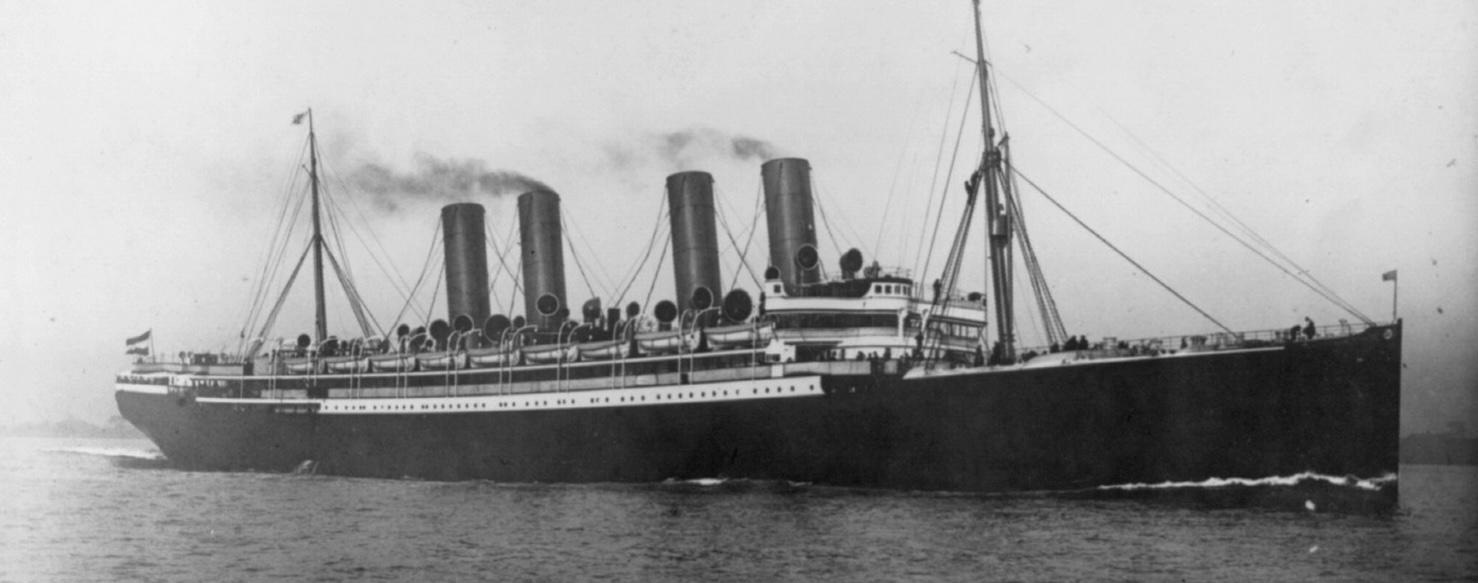
SS Kaiser Wilhelm der Grosse
Norddeutscher Lloyd · entered service 1897 · Ship Guide
Overview
SS Kaiser Wilhelm der Grosse was the ship with which Norddeutscher Lloyd decisively entered the late-nineteenth-century North Atlantic prestige race. Built by AG Vulcan at Stettin and launched on 4 May 1897, she combined high speed, large passenger capacity, and a four-funnel profile that became one of the defining visual signatures of the great express liners that followed.
Her importance extends beyond appearance. In 1898 she established a westbound Atlantic record and became the first German liner generally credited with taking the Blue Riband from British competition. In 1900 she received a permanent Marconi wireless installation at a moment when commercial ship-to-shore radio was still experimental. In August 1914 the same prestige liner was converted into an auxiliary cruiser and was lost off Río de Oro after action with HMS Highflyer.
Key Facts
A New German Express Liner
North German Lloyd had already developed large twin-screw passenger and cargo ships, but Kaiser Wilhelm der Grosse represented a different proposition: a purpose-built express mail steamer intended to challenge the fastest British liners directly. Contemporary NDL history preserved by Norway-Heritage describes the company ordering the ship from Vulcan after experience with twin-screw machinery had matured, and records the enormous public attention surrounding her 1897 debut.
The four funnels became inseparable from the ship's identity. Later advertising and retrospective accounts made the silhouette shorthand for speed, scale, and prestige. The safest formulation is that she was the first purpose-built four-funnel ocean liner; Great Eastern had earlier carried four funnels only after alteration and was no longer operating in the same passenger-liner role.
Records and the Blue Riband
Her early career was built around record passages. Norway-Heritage's voyage chronology records successive fast crossings in 1897 and a westbound passage completed on 5 April 1898 in roughly five days, for which the ship is credited with taking the Blue Riband. The achievement mattered because British ships had dominated the symbolic contest for transatlantic speed.
Blue Riband language requires care. It was not a formally administered trophy during this period, and eastbound and westbound performances must not be collapsed into a single permanent title. Record times also vary according to the exact measuring points and contemporary reporting conventions. This guide therefore treats the April 1898 passage as a specific directional record rather than an eternal attribute of the ship.
Wireless at Sea
In February 1900 Kaiser Wilhelm der Grosse received a permanent Marconi wireless installation. A contemporary note in the U.S. Naval Institute's Proceedings called her the first merchant steamer to receive permanent wireless equipment and described successful communication with the Borkum shore system during her regular service.
That distinction is worth stating narrowly. Experimental wireless work aboard ships predated the installation, and other vessels had already participated in demonstrations. The significance here is the transition from experiment toward permanent commercial equipment on an operating liner. Guglielmo Marconi later identified Kaiser Wilhelm der Grosse during the 1912 British Titanic inquiry as the first large liner fitted with his system.
From Prestige Liner to Auxiliary Cruiser
At the outbreak of the First World War the ship was taken into German naval service and armed as an auxiliary cruiser. Her raiding career was short. After operations off West Africa she entered Río de Oro to coal, where HMS Highflyer found her in late August 1914.
The surviving British log account records a demand for surrender, the opening of fire, an action lasting about an hour, and the German ship listing heavily before going over on her side. Later narratives differ over whether British gunfire itself sank the liner or whether her crew deliberately completed the loss by scuttling after ammunition was exhausted. The strongest evidence supports describing the result without forcing those traditions into artificial agreement: Kaiser Wilhelm der Grosse was disabled in action and intentionally abandoned, ending her career off Río de Oro on 26 August 1914.
Interpretive Notes
Kaiser Wilhelm der Grosse matters because several strands of ocean-liner history meet in one hull: German industrial ambition, the North Atlantic speed race, the four-funnel prestige aesthetic, the beginnings of permanent commercial wireless, and the wartime conversion of passenger tonnage. Her career is unusually compact, running only seventeen years, yet the design language she helped popularize remained recognizable long after her loss.
For attribution work, date and context remain essential. The ship's profile is distinctive, but NDL's later four-funnel express liners deliberately shared much of its visual language. Advertising may also use the flagship generically. Funnels, mast arrangement, superstructure proportions, printed captions, publisher, and date should be considered together before identifying an image or artifact.
Evidence-first ship guideSources (Selected)
- Ocean Liner Curator — Sources (master bibliography)
- Norway-Heritage — Kaiser Wilhelm der Grosse chronology and specifications
- Norway-Heritage — Norddeutscher Lloyd fleet history
- U.S. Naval Institute Proceedings (1900) — permanent Marconi installation
- British Wreck Commissioner's Inquiry — testimony of Guglielmo Marconi, 1912
- Naval-History.net — HMS Highflyer log and 1914 action
- Library of Congress — contemporary photographic record, c.1897