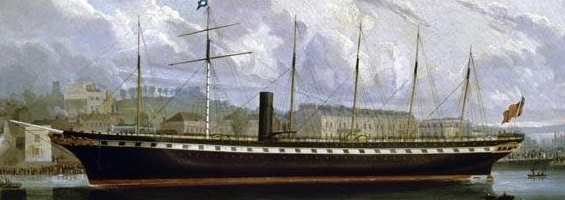
SS Great Britain
Great Western Steamship Company · 1843 / 1845 · Ship Guide
Overview
SS Great Britain was one of the most important ships in nineteenth-century maritime history and a foundational vessel in the development of the modern ocean liner. Designed by Isambard Kingdom Brunel for the Great Western Steamship Company, she was launched in 1843 and entered service in 1845. Her significance lies in the unprecedented combination of large scale, iron hull construction, and screw propulsion in a transoceanic passenger ship. In that sense, Great Britain should be understood not merely as an early steamer, but as a major technological threshold vessel.
In interpretation, Great Britain matters less as a mature “luxury liner” in the later Atlantic sense and more as a breakthrough ship whose design helped redefine what an ocean-going steam passenger vessel could be.
Key Facts
Figures for Great Britain vary across sources because nineteenth-century tonnage and dimension reporting was not always standardized in the same way later registry practice became. For cataloging, it is best to preserve the exact wording and measurement basis of the cited source.
Design & Construction Context
Great Britain was radical for her time. Brunel and his collaborators moved beyond the earlier large wooden paddle steamer and produced a ship that combined iron construction with screw propulsion at an unprecedented scale. That combination is the key point. Iron hulls existed before, and screw propulsion existed before, but Great Britain brought them together in a major ocean-going passenger ship in a way that reshaped expectations for the future.
She therefore belongs to a different interpretive category from many early mail steamers. Her importance does not rest chiefly on route regularity alone, nor on later luxury language, but on engineering transition. She stands at the moment when the steam passenger ship ceased to be merely an adaptation of earlier forms and became recognizably modern in structure and propulsion logic.
Service History (Summary)
1843 launch: Great Britain was launched at Bristol on 19 July 1843 and immediately attracted attention as the largest ship in the world. Even before entering service, she had already become a landmark in ship design.
1845 entry into service: Her maiden voyage began on 26 July 1845 from Liverpool to New York. She subsequently became the first iron steamer to cross the Atlantic, proving that a large iron, screw-driven steamship could operate successfully on an ocean route.
Early transatlantic career: In her original role, Great Britain served the Britain–New York trade, but her commercial career under the Great Western Steamship Company was troubled. The company’s financial position was already weak, and the ship’s grounding in Dundrum Bay in 1846 further damaged her original operating context.
1850s change of role: After salvage and sale, she entered a different but historically important phase as a long-distance emigrant carrier, especially on the Australia route. This later career moved her away from her original Brunel-era prestige Atlantic identity and into a broader imperial and migration history.
Later conversion: In the late nineteenth century she was converted to sail, reflecting the practical afterlife many steamships could have once their original propulsion systems no longer suited profitable service. This is important evidence that ship identities could change radically over time.
Preservation era: Unlike most ships of her generation, Great Britain survived into the modern era and is now preserved at Bristol. That survival has understandably made her one of the best-known nineteenth-century steamships in public memory.
Interpretive Notes
This is a breakthrough technological ship, not yet a mature later liner in the Edwardian sense: Great Britain should not be described with assumptions borrowed from the later age of large express liners and highly stratified passenger luxury.
Her importance lies in combination: the crucial historical claim is not simply “iron” or simply “screw,” but the successful joining of those features in a major ocean-going passenger vessel.
She belongs to ocean-liner prehistory and liner history at once: Great Britain is early enough to feel experimental, yet advanced enough to point directly toward the later modern liner.
The Atlantic crossing matters symbolically and materially: being the first iron steamer to cross the Atlantic was not just a publicity point. It demonstrated that the future of large passenger shipping would not remain tied to wooden hulls and paddle propulsion.
Her Australian emigrant phase should be kept distinct from her Brunel Atlantic phase: both are historically important, but they belong to different interpretive frames and should not be collapsed into a single undifferentiated career story.
Evidence-first ship guideSources (Selected)
- Ocean Liner Curator — Sources (master bibliography)
- Brunel’s SS Great Britain — launch significance and technological importance
- Royal Museums Greenwich — dimensions, hull, propulsion, and design summary
- National Historic Ships UK — registry dimensions and tonnage
- Britannica — broad historical significance and technological summary