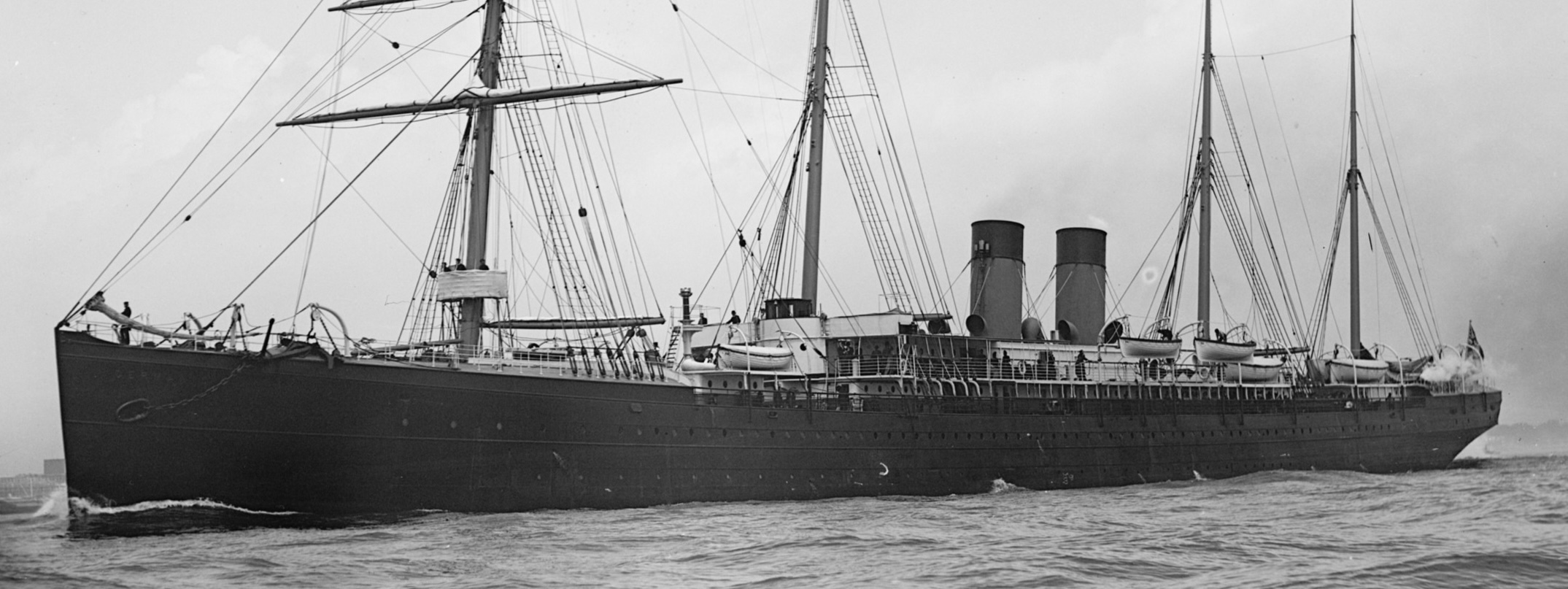
SS Germanic
White Star Line · entered service 1875 · Ship Guide
Overview
SS Germanic was the sister of Britannic and one of the most remarkably long-lived ships ever associated with White Star. Harland & Wolff launched her on 15 July 1874, and she entered Liverpool–New York service on 20 May 1875.
Her story is unusually layered. After decades with White Star she became Ottawa in Canadian service, then entered Ottoman ownership as Gül Djemal, later Gülcemal, surviving until 1950. One hull therefore generated authentic material under several names, operators, routes, and political systems.
Key Facts
White Star's Early Atlantic World
Germanic belonged to the same commercial system as Britannic: first-class saloon travel above a very large migration business. Her roughly 1,500 third-class berths made ordinary transatlantic movement central to the ship's purpose.
This is the context in which early White Star passenger lists, luggage labels, menus, route advertisements, and agent material should be read. The ship was a prestige liner, but also a mass transport vessel.
Record Crossings
In 1876–77 Germanic achieved celebrated record passages that placed her among the leading North Atlantic steamers of the decade. The specific westbound crossing of 7 days, 15 hours, 37 minutes is especially often cited.
As with Britannic, the record story is useful because it complicates a simplistic “comfort instead of speed” reading of White Star. The line was perfectly willing to benefit from speed prestige when its ships delivered it.
The 1895 Reconstruction
After twenty years of service, Germanic underwent a major modernization in 1895. New triple-expansion machinery, new boilers, and changes to deck and superstructure materially altered the ship.
This rebuild is a major photographic and technical breakpoint. Pre-1895 and post-1895 images can depict meaningfully different versions of the same vessel, and specifications should be tied to the relevant period wherever possible.
The 1899 Capsize
In February 1899, while lying at New York, heavy snow and ice accumulation contributed to the ship capsizing at her berth. She was later raised and returned to service.
The incident is a dramatic episode, but it belongs within a much longer working life. It also reminds us that dockside casualties could be serious without ending a ship's career.
Ottawa
After a brief American Line phase within the IMM system, the ship was sold to Dominion Line in 1905 and renamed Ottawa. She entered Canadian service, including Liverpool–Halifax and seasonal Quebec/Montreal routes.
The rename should be treated as a hard provenance boundary. A Canadian-route artifact labeled Ottawa belongs to a different operator and market from White Star-era Germanic material.
Gül Djemal / Gülcemal
Sold to Ottoman owners in 1911, the former Germanic entered an extraordinary third life as Gül Djemal. She served in roles including troop transport and passenger work, survived a torpedo attack in 1915, and later continued under the Turkish Republic as Gülcemal.
That longevity is one of the most remarkable aspects of the hull's history. A vessel designed for the 1870s North Atlantic remained in service into the mid-twentieth century, crossing radically different political and commercial worlds.
Passenger Capacity and Social History
Germanic's original accommodation—roughly 220 first-class and 1,500 third-class passengers—makes clear that migration was central to the ship's business. The scale of third-class travel is one of the strongest clues to how White Star actually earned revenue and how the liner functioned socially.
That balance also helps explain the kinds of material most likely to survive. Company advertising and saloon imagery may emphasize prestige, while passenger lists, immigration records, and family archives preserve the much larger story of ordinary movement across the Atlantic.
Fleet and Technology Context
Germanic was the last iron-hulled ship built for White Star before the company's shift to steel construction. That makes her an especially useful endpoint for the earlier material tradition represented by the first White Star steamers.
The 1895 reconstruction then pushed the ship forward technologically, replacing original machinery and materially altering the vessel. Few ships illustrate so clearly how a successful hull could be repeatedly modernized to remain commercially useful.
Interpretive Notes
Name discipline is essential. Germanic, Ottawa, and Gül Djemal/Gülcemal are one hull but not one documentary identity.
The 1895 rebuild should also be treated as a structural provenance break, and record claims should remain tied to specific direction and date rather than generalized into “fastest ship” language.
Evidence-first ship guide