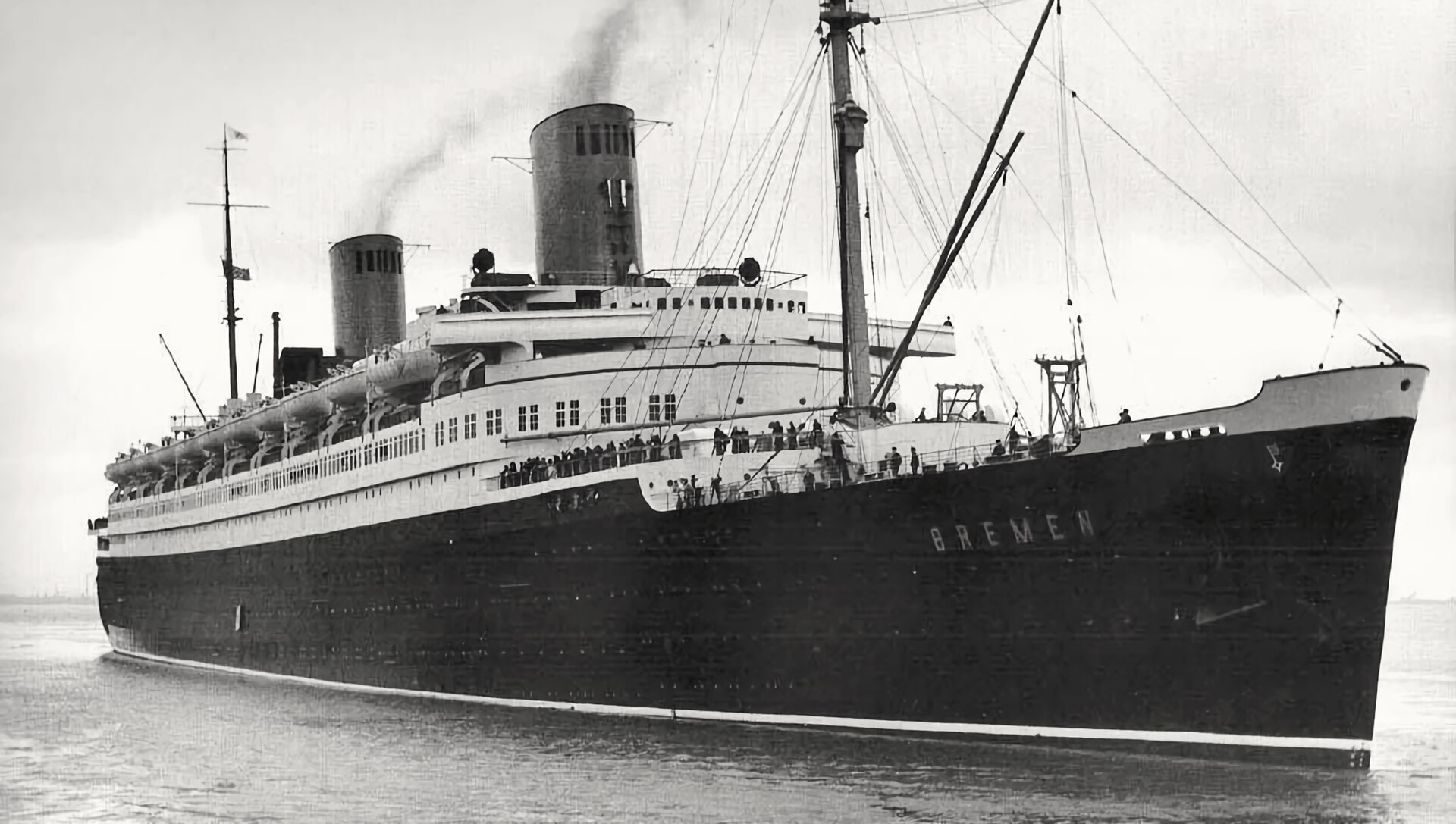
SS Bremen
Norddeutscher Lloyd · entered service 1929 · Ship Guide
Overview
SS Bremen was Norddeutscher Lloyd’s headline express liner of the late interwar years—built to restore German prestige on the North Atlantic through speed, modernity, and a deliberately “new” profile. Entering service in July 1929, she and her sister Europa were conceived to sustain a two-ship weekly schedule at a very high cruising speed—an operational flex with real marketing weight.
Bremen is best known for a single, highly documentable claim: on her maiden transatlantic crossing (July 1929) she captured the westbound Blue Riband with an average speed commonly cited as 27.83 knots. The voyage also helped popularize a hybrid idea of “speed”: not only fast passage, but fast communications—via ship-launched seaplane airmail delivered ahead of arrival.
Evidence-first note: the name “Bremen” was carried by multiple Norddeutscher Lloyd ships. In titles, captions, and catalog records, consider adding “(1929)” or “Bremen IV” when precision matters.
Key Facts
Design & Construction (Context)
In design terms, Bremen belongs to the interwar “streamlined” moment: low superstructure lines, a controlled silhouette, and an engineering-first aesthetic that read as modern even in photographs. She was built for sustained high speed rather than a single spectacular dash—Norddeutscher Lloyd intended her to keep a weekly timetable with only two ships, a logistical advantage that translated into brand authority.
One detail matters for curatorial writing: the ship’s “speed story” is not just the Blue Riband. The much-publicized airmail system (catapult seaplane launched at sea to deliver mail ahead of docking) produced a distinct class of collectible material—airmail covers, cachets, and voyage-specific ephemera where the date and route are often explicit.
Service History (Summary)
1929–mid-1930s: Prestige express service. Bremen entered service in July 1929 and immediately won the westbound Blue Riband on her maiden crossing. Through the early 1930s she operated the standard Bremerhaven–Southampton–Cherbourg–New York run, projecting German industrial and commercial confidence during a volatile economic period.
Material culture and documentation. Because Bremen was a flagship, the paper trail is unusually rich: illustrated brochures, cabin-class guides, passenger lists, menus, and onboard stationery. These are not just “souvenirs”—they are evidence objects that can often be pinned to a specific sailing, class structure, or branding campaign.
1939–1941: War disruption and destruction by fire. With the outbreak of war, her commercial passenger career ended. She was later laid up at Bremerhaven, where a fire on 16 March 1941 left the ship gutted. Later accounts describe scrapping to the waterline and final disposal after the war.
Interpretive Notes
Bremen is a useful “systems ship” for the interwar Atlantic: she shows how speed, schedule, advertising, and national prestige could be braided together into a single object. But don’t let the prestige flatten the evidence. A menu dated to a particular crossing is more historically valuable than a generic “Bremen souvenir” because it anchors the ship in time and use.
For attribution, watch for two common errors: (1) confusing multiple ships named Bremen, and (2) treating any Norddeutscher Lloyd item as ship-specific. When in doubt, prioritize items that carry voyage date/port chain, ship imagery that matches hull/funnel details, or a printer’s imprint that can be traced.
Modernity and national prestige: Bremen represented a deliberate German attempt to return to the front rank of North Atlantic passenger service after the First World War. Her design, machinery, speed, and visual profile belonged to the late-1920s modernist break with the older four-funnel express tradition.
Her ending requires equally careful chronology. The 16 March 1941 fire at Bremerhaven, supported by German Maritime Museum evidence, was an arson event; the damaged hull later remained in the Weser before final disposal. That sequence is more precise than shorthand descriptions that collapse fire, wreck, and scrapping into one moment.
That distinction matters historically.
Evidence-first ship guide