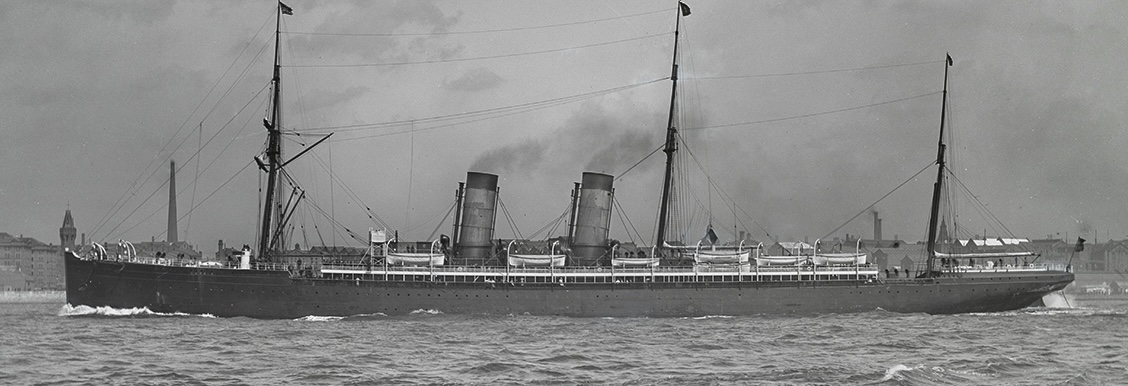
RMS Umbria (1884)
Cunard Line · launched 1884 · Ship Guide
Overview
RMS Umbria was one of Cunard's principal express liners of the 1880s and the near-identical sister of RMS Etruria. John Elder & Co. at Govan built her as yard no. 285. She was launched on 25 June 1884, completed in October, and departed Liverpool on her maiden voyage to New York via Queenstown on 1 November 1884.
The former version of this guide contained a cluster of serious inherited errors. Umbria was not twin-screw, yard no. 358, or a First World War casualty. Like Etruria, she used one three-cylinder compound engine driving a single screw and retained auxiliary sail. She remained a Cunard liner until 1910 and was then broken up at Bo'ness, Scotland.
Her genuine career was eventful enough without the erroneous 1915 story. In 1887 she took the westbound Atlantic record from Etruria, averaging about 19.22 knots over a passage of 6 days, 4 hours and 12 minutes. Etruria recovered the record the following year.
Key Facts
Launch references vary by one day, with some retrospective databases giving 26 June. Contemporary and major summary sources commonly give 25 June; the discrepancy should be retained in research notes rather than silently treated as impossible.
A Transitional Express Liner
Umbria and Etruria were among Cunard's last express liners to carry auxiliary sails. Their machinery represented the mature end of compound-engine development just as triple-expansion engines were becoming standard in new merchant ships. They therefore sit at a particularly revealing technological boundary: large, fast, competitive steamships whose rig and single-shaft arrangement still preserved features associated with an earlier period.
The single screw is not a minor specification. It shaped the ship's operational vulnerability as well as her appearance. When a shaft failure occurred in December 1892, Umbria could not simply continue on a second propeller; improvised repairs, attempted towing, and the surviving sail rig all became part of the response.
Record Passages
On the westbound passage that ended on 4 June 1887, Umbria crossed from Queenstown to Sandy Hook in 6 days, 4 hours and 12 minutes over approximately 2,848 nautical miles, averaging 19.22 knots. Blue Riband chronologies place that performance between Etruria's 1885 and 1888 records.
The Blue Riband was not an official prize governed by a single contemporary authority. It is best treated as a historical convention applied to recognized fastest Atlantic passages. The measured voyage remains meaningful even without turning the label into a formal trophy.
Service Incidents
1885: during the Anglo-Russian war scare, Umbria was temporarily chartered by the Admiralty and fitted out as a merchant cruiser. The crisis passed without the anticipated war, and she returned to regular service.
10 November 1888: while outward bound from New York, Umbria collided with and sank the Fabre Line steamer Iberia near Sandy Hook. Later accounts attributed responsibility to Umbria's speed in the prevailing conditions.
December 1892: a propeller-shaft failure left the single-screw liner disabled in the Atlantic. A tow by Hamburg America Line's Bohemia failed in bad weather; after difficult work aboard Umbria, temporary repairs enabled her to reach New York.
1900: she made transport voyages associated with the Second Boer War, another example of a major passenger liner being drawn temporarily into government service.
1910: after roughly twenty-five years of North Atlantic service, Umbria was withdrawn and sent to Bo'ness for breaking.
The 1903 Bomb Scare
On 9 May 1903, while Umbria was at New York preparing to sail, police received a warning that an explosive device had been sent to the Cunard pier. A search located a box containing roughly 100 pounds of dynamite connected to a timing mechanism. The device was removed and rendered safe, and the ship later sailed without incident.
Contemporary claims about who was responsible were contradictory, and later retellings sometimes turn those claims into certainty. The most defensible formulation is narrower: a genuine explosive device was found, the sailing was delayed, and the attribution of the plot remained disputed.
Why Umbria Matters
Umbria sits at a technological hinge in Cunard history. She was fast enough to hold the westbound Atlantic record yet retained a single screw, compound machinery, and auxiliary sail. Her 1892 shaft failure demonstrates why those apparently old-fashioned sails still had operational meaning, while her later career shows how quickly such machinery was eclipsed by triple-expansion and turbine liners.
Interpretive Notes
Sister-ship attribution: Umbria and Etruria were visually very similar. Dated printed identification, voyage information, and ship name are stronger evidence than silhouette alone.
Do not import another ship's wartime fate: there was no 1915 Red Sea scuttling in Umbria's history. Her documented endpoint is ordinary but historically important: retirement and scrapping in 1910.
Technology and operations belong together: her record speed, auxiliary rig, and shaft emergencies are all parts of the same design story. Treating specifications as isolated numbers misses that relationship.
Evidence-first ship guide