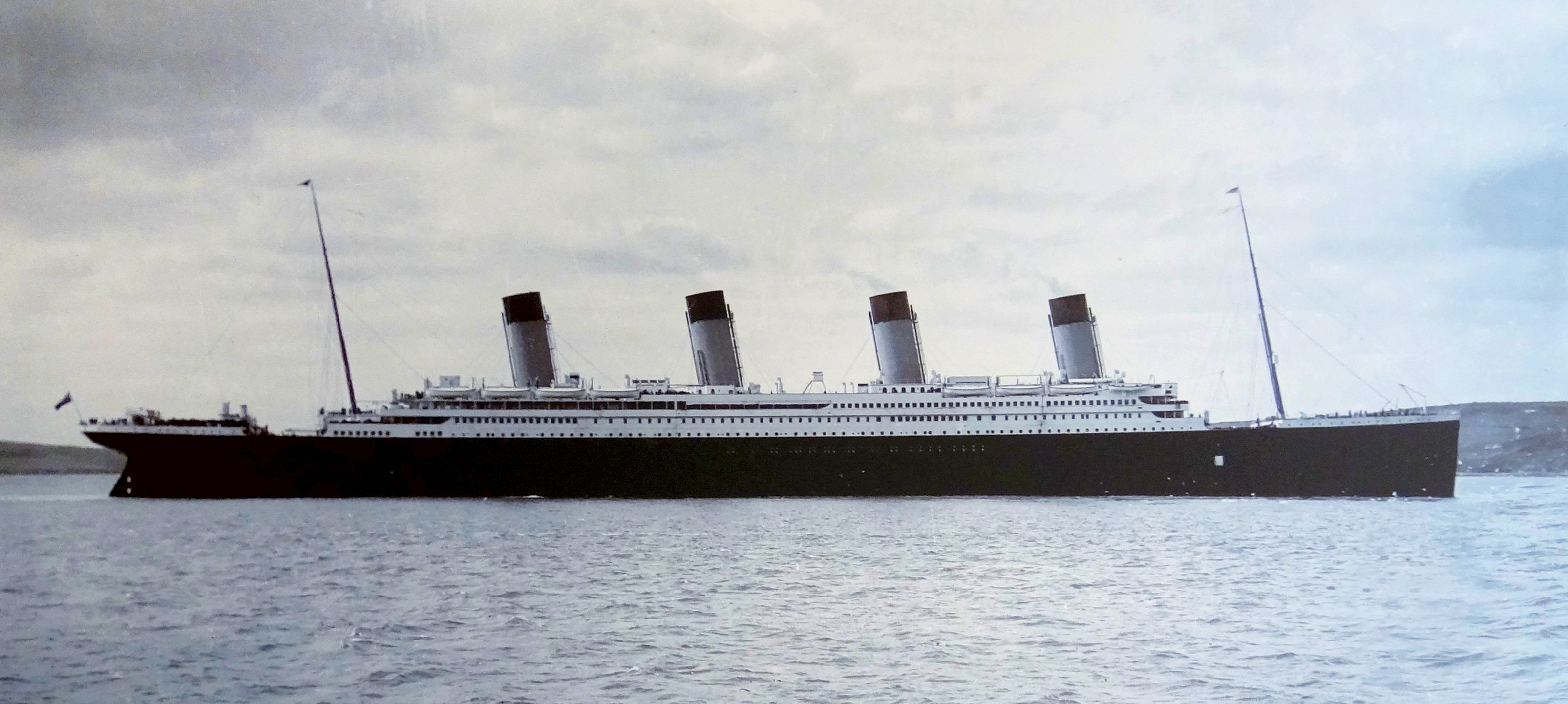
RMS Titanic
White Star Line · 1912 · Ship Guide
Overview
RMS Titanic was an Olympic-class liner built for the White Star Line and entered service in 1912. She is best known for the April 1912 disaster on her maiden voyage, an event that reshaped maritime safety regulation, public expectations of passenger-ship risk, and the later collecting ecosystem surrounding the ship’s material culture.
This page is written as a reference doorway: it summarizes widely documented facts, flags uncertainty where it exists, and resists turning folklore, film imagery, or repeated anecdotes into “record” without evidence.
Key Facts
Note on passenger counts and casualty totals: exact numbers can vary slightly by source because of late changes, record-keeping practices, and differing methods for categorizing “on board.” For high-stakes precision, cite the inquiry evidence and published passenger lists.
Design & Construction (Context)
Titanic was conceived in the same competitive environment as Olympic: prestige, comfort, and schedule reliability on the North Atlantic. Her design combined large passenger capacity with contemporary safety practices and shipboard “systems” that were advanced for the period, while still reflecting the regulatory and operational assumptions of the early 1910s.
For collectors, the construction context matters because many objects attributed to Titanic are actually “Olympic-class” in style rather than provably from the ship: patterns, suppliers, and fittings can be shared across sisters and even across fleets.
Service History (Summary)
Titanic had an exceptionally short service life: she sailed her maiden voyage from Southampton on April 10, 1912, calling at Cherbourg and Queenstown (Cobh) before heading west across the Atlantic. Late on April 14 she struck an iceberg, and in the early hours of April 15 she sank.
Subsequent historical “service” is therefore not operational but documentary: the official inquiries, survivor testimony, wireless records, contemporary press, and later archaeological work. These sources form the backbone of evidence-first statements about the ship.
Aftermath & Research Notes (High-level)
The disaster accelerated (and in some cases forced) changes in safety practice: lifeboat provisioning standards, wireless watch expectations, and the institutional framework for ice patrol and international safety conventions. When discussing “what changed,” it’s worth anchoring claims to inquiry findings and the published evolution of regulations rather than to retrospective summaries alone.
The wreck’s 1985 discovery and later expeditions created a second documentary layer: photography, mapping, artifact recovery debates, and a continuing legal / ethical conversation about disturbance, conservation, and exhibition. These topics can be handled as “sources about sources”: what is claimed, what is shown, what is archived, and what is interpretive.
The 1912 Inquiry Record
The British Wreck Commissioner's Inquiry remains one of the most important primary documentary frameworks for understanding the disaster. It sat for thirty-seven public sessions, heard ninety-seven witnesses, examined plans, charts, wireless records, and other documents, and organized its findings around the ship's design, navigation, lifesaving arrangements, wireless installation, casualty sequence, and rescue.
The inquiry recorded twenty boats in total: two emergency boats, fourteen standard lifeboats, and four Engelhardt collapsibles, with an aggregate carrying capacity of 1,178 people. It also found that the arrangements for manning and launching the boats were not proper and sufficient and that no boat drill had been held before the voyage.
Safety Reform in Precise Context
The disaster did not produce one single isolated rule change. The inquiry recommended a broader safety program that included improved boat provision and organization, recorded drills, continuous wireless service by trained operators, greater caution when ice was reported near the track, and international coordination on subdivision, lifesaving appliances, wireless practice, and navigation near ice.
That distinction matters. It is more accurate to say that Titanic exposed weaknesses in a regulatory system whose requirements had not kept pace with ship size and operating technology than to reduce the aftermath to a single slogan such as “enough lifeboats for everyone.”
Evidence, Myth, and Sister-Ship Confusion
Because Titanic had almost no service career before the disaster, later interpretation depends unusually heavily on construction records, inquiry evidence, surviving ephemera, photographs, and comparison with Olympic. That comparison is indispensable, but it is also a major source of error when an Olympic photograph, fitting, or room detail is presented as direct evidence for Titanic without qualification.
The strongest curator practice is therefore layered: use direct Titanic evidence where it exists, use sister-ship evidence transparently where necessary, and keep reconstruction or inference labeled as such.
Interpretive Notes
Titanic is one of the most story-saturated ships in history. That saturation creates predictable distortions: visual misconceptions from film, conflation of sister-ship details, invented dialogue re-circulated as “quotes,” and confident provenance claims that collapse under basic documentation checks.
Ocean Liner Curator treats popular narratives as leads, not conclusions. If a detail materially changes interpretation (e.g., “this item is definitely from Titanic,” “this practice was standard,” “this design choice caused X”), it should be supported by sources you would cite publicly: inquiry transcripts and exhibits, builder documentation, contemporary photographs, reputable institutional scholarship, or clearly documented chains of custody for objects.
Evidence-first ship guideSources (Selected)
This list is intentionally conservative. Prefer inquiry records, reputable archives, and carefully cited scholarship.
- Ocean Liner Curator — Sources (master bibliography)
- Encyclopedia Titanica — reference hub (cross-check against primary documentation)
- The National Archives (UK) — government records discovery (inquiry-related material)
- National Maritime Museum (UK) — collections & research entry points
- Library of Congress — period newspapers, photographs, and related collections
- British Wreck Commissioner's Inquiry — Findings of the Court
- British Wreck Commissioner's Inquiry — Recommendations