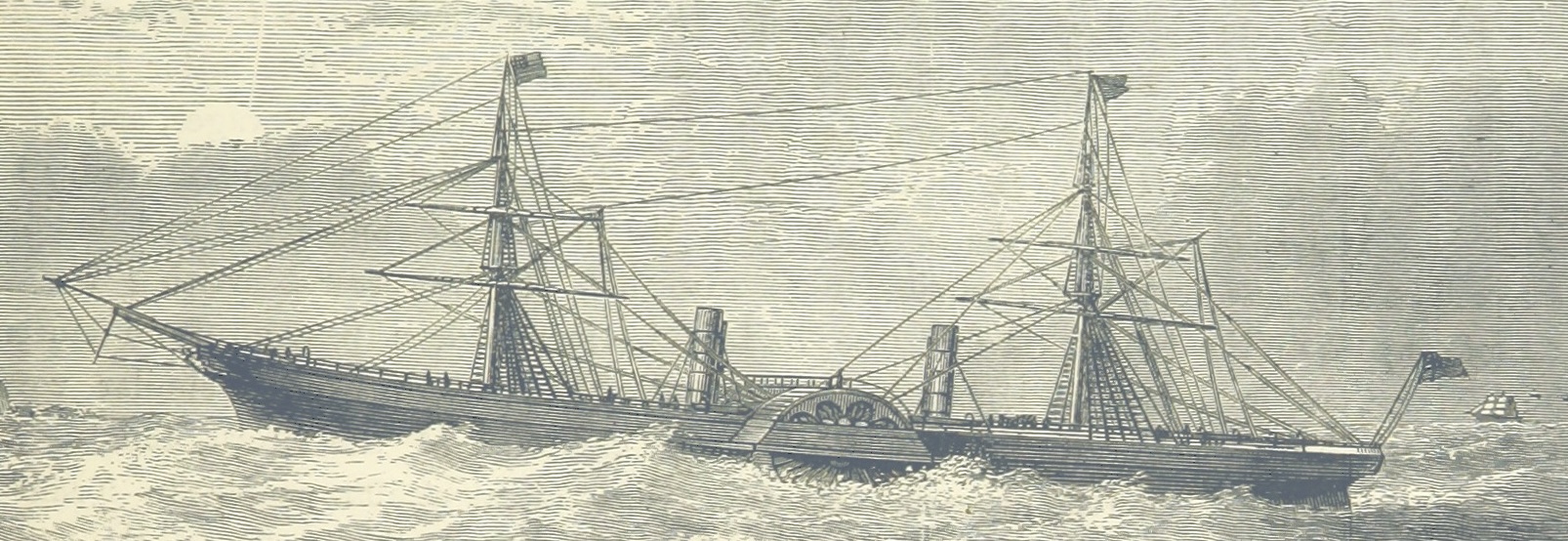
RMS Scotia
Cunard Line · 1861 / 1862 · Ship Guide
Overview
RMS Scotia occupies a distinctive place in Atlantic liner history as Cunard’s final major transoceanic paddle steamer and one of the last great expressions of that propulsion type on the North Atlantic. Built for the Liverpool–New York service and entering service in 1862, she belongs to a moment when Atlantic steam navigation had already proved itself operationally reliable, yet had not fully surrendered its premier routes to the screw-propelled express liner. In that sense, Scotia stands less at the beginning of the liner story than at the end of one of its early technological branches.
In interpretation, Scotia should be understood as both a culminating paddle-mail liner and a transitional ship. She was advanced, powerful, and prestigious, but she also represents a type already nearing technological eclipse.
Key Facts
Dimensions and technical figures for nineteenth-century steamships often vary slightly across summaries depending on whether the source gives between-perpendiculars measurements, overall length, nominal versus indicated horsepower, or registry phrasing. For cataloging, it is best to keep the cited wording and units intact.
Design & Construction Context
Scotia was built by Robert Napier & Sons at a time when Cunard still trusted the paddle steamer for prestige Atlantic work, even as screw propulsion was increasingly proving its long-term superiority. She was larger than earlier Cunard mail steamers and incorporated substantial structural improvements, including an iron hull and a more highly developed internal safety arrangement than the first generation of wooden Atlantic paddlers. Contemporary observers regarded her as one of the strongest merchant steamers afloat.
Visually and technologically, Scotia belongs to a fascinating threshold moment. Her two funnels, side paddles, and large Atlantic profile still evoke the great paddle era, yet her scale and performance placed her near the mature express-liner world that screw propulsion would soon dominate. She is therefore best read as a culminating form rather than an experimental dead end: a ship type brought close to its highest refinement just before being overtaken.
Service History (Summary)
1861 launch: Scotia was launched on 25 June 1861 for the Cunard Line. She emerged from the Napier yard as a prestigious Atlantic mail steamer and one of the largest and strongest paddlers yet placed into regular transoceanic service.
1862 entry into service: Her maiden voyage began on 10 May 1862 from Liverpool to New York. She quickly entered the main Cunard Atlantic pattern and represented the line’s continuing confidence in scheduled, high-quality mail and passenger service on the premier North Atlantic route.
1863 speed record achievement: Scotia gained particular fame by taking the Blue Riband in 1863 for fast Atlantic crossings. This matters interpretively because it demonstrates that the paddle liner, even in its final Atlantic phase, could still deliver top-level performance against contemporary rivals.
1860s–1870s Cunard service: During her working Cunard career, Scotia served not as an immigrant giant or later floating palace, but as a first-rank mid-Victorian Atlantic liner—substantial, disciplined, and performance-oriented. Even after newer screw ships began to define the future, she remained a notable and capable vessel in service.
1876 withdrawal from Atlantic passenger service: By the mid-1870s the paddle express liner had become technologically outclassed on the main Atlantic route. Scotia was laid up in 1876, closing her most important career phase as a Cunard passenger and mail steamer.
Conversion to cable work: Rather than passing directly into obscurity, she began a second life after conversion for submarine cable service. This altered her function substantially and should be treated as a separate interpretive phase from her Cunard liner identity.
1904 loss: In her later cable-ship career she was wrecked off Guam in 1904. That end belongs to the long afterlife of a repurposed vessel rather than to the Atlantic prestige role for which she is historically best remembered.
The Final Cunard Voyage
Scotia made her final Liverpool–New York passenger voyage on 29 May 1876. That date is a useful boundary for attribution: later photographs, plans, and technical descriptions may belong to the industrial cable-ship phase rather than to the famous Cunard paddle liner.
Conversion to Cable Ship
After sale in 1878, Scotia was converted in 1879 for cable work. The transformation was profound: paddle propulsion was abandoned in favor of twin screws and the vessel’s commercial purpose shifted from mail and passenger service to submarine telegraph construction and repair.
She spent roughly a quarter-century in this second career, including cable work between Europe and Asia and later Pacific service. In 1903 she passed to Pacific cable interests and operated from Guam.
Loss at Guam
On 11 March 1904, Scotia was wrecked on Spanish Rock off Guam. The casualty belongs to the cable ship, not to the Cunard liner configuration, and should be labeled accordingly.
Record Passage and Blue Riband Caution
Norway Heritage records Scotia’s December 1863 Queenstown–New York passage at 8 days 3 hours, the first listed crossing under nine days in that compilation. Blue Riband tables do not all assign identical start and end years, so a catalog label should cite the specific record or source rather than treating the title as one universally fixed chronology.
The 1896 Cable-Ship Explosion
Scotia’s cable career included a serious 1896 explosion in an anti-fouling paint store while she was off Eddystone. The forward part of the ship was badly damaged, but her robust iron structure allowed her to survive and return for repair. This episode belongs to the later cable ship, not to the Cunard passenger configuration.
Sale-Date Source Disagreement
Secondary sources differ over whether to describe the transfer to Telegraph Construction & Maintenance as a 1876 sale, a later purchase in 1878, or a 1879 acquisition tied to conversion. The secure sequence is withdrawal from passenger service in the mid-1870s followed by major conversion to twin-screw cable work completed by 1879. This guide preserves that sequence without forcing false precision where the sources disagree.
Why Scotia Matters
Scotia is unusually valuable because she closes one technological chapter and opens another. As a Cunard liner she represents the mature peak of Atlantic paddle propulsion; as a cable ship she became infrastructure for the global communications network that increasingly bound the same oceans together.
Interpretive Notes
This is a culminating paddle liner, not an early primitive steamer: Scotia should not be grouped too casually with the first small Atlantic mail steamers. She represents a much more mature, powerful, and structurally advanced phase of paddle-steamer development.
But she is also not a modern screw express liner: her importance lies partly in the fact that she shows how far the paddle liner could be developed before the screw-propelled Atlantic liner became fully dominant.
Her Blue Riband matters: the record passages underscore that Scotia was not merely conservative or residual technology. She was still a serious performance ship in the competitive Atlantic environment of the 1860s.
Her real historical value lies in transition: Scotia stands at the junction between one Atlantic regime and another. She helps explain how the liner evolved from paddle prestige to screw-driven express modernity.
The cable-ship career should be treated separately from the Cunard phase: later rebuilding and industrial service are historically interesting, but they belong to a different interpretive frame than her identity as Cunard’s last great Atlantic paddle liner.
Evidence-first ship guideSources (Selected)
- Ocean Liner Curator — Sources (master bibliography)
- Norway Heritage — Scotia fleet summary, dimensions, launch date, maiden voyage, and later service notes
- National Museums Liverpool / Migration to New Worlds — archival note on launch, design development, and maiden voyage
- Cunard Shipwrecks — Cunard service, cable-ship conversion, and 11 March 1904 wreck
- GG Archives — RMS Scotia archival collection and final Cunard voyage
- Blue Riband reference table — 1863 record passages credited to Scotia
- Atlantic Cable — later cable-ship career context for Scotia
- Norway Heritage — SS Scotia service chronology
- History of the Atlantic Cable — CS Scotia