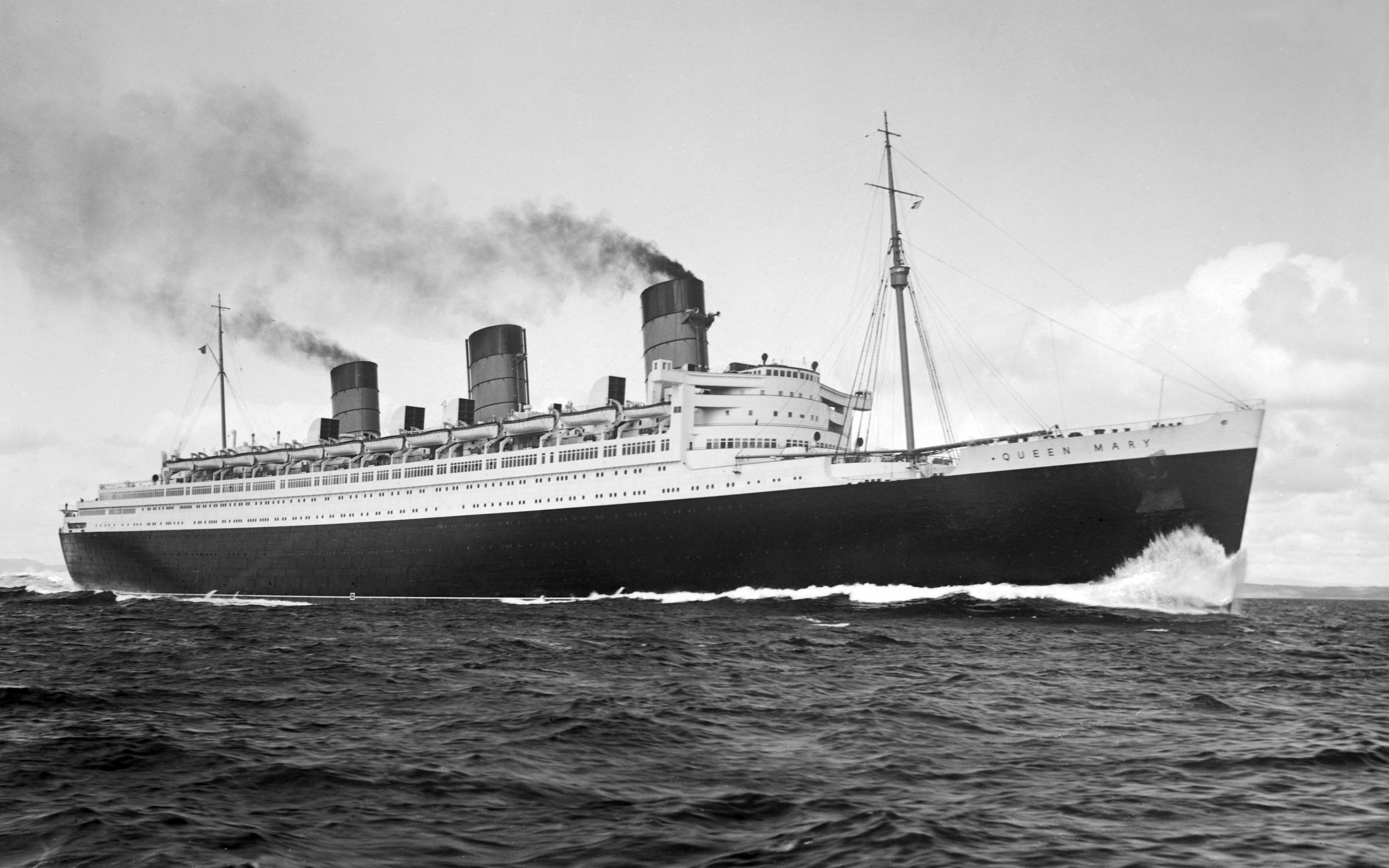
RMS Queen Mary
Cunard-White Star · entered service 1936 · Ship Guide
Overview
RMS Queen Mary was built by John Brown & Company at Clydebank as yard no. 534 for Cunard's new generation of North Atlantic express service. Launched on 26 September 1934 and delivered on 12 May 1936, she left Southampton on her maiden voyage on 27 May 1936.
Her history is unusually well documented because the ship survives. That makes it possible to distinguish her record from later legend: the Blue Riband passages, wartime troop movements, collision with HMS Curacoa, return to commercial service, 1967 retirement, and preservation at Long Beach all rest on extensive contemporary or institutional evidence.
Key Facts
Design, Construction, and the Two-Ship Express Strategy
Queen Mary emerged from an interwar contest in which speed, national prestige, shipbuilding capacity, and dependable schedules were inseparable. Construction of John Brown yard no. 534 began before the worst of the early-1930s economic crisis, then stalled as Cunard struggled to finance completion. Government-backed restructuring and the Cunard–White Star merger allowed work to resume, tying the ship's completion to a broader reorganization of British transatlantic shipping.
The result was not intended as a one-off showpiece. Queen Mary and the later Queen Elizabeth formed a two-ship express system designed to maintain a regular North Atlantic service with large, fast liners operating in tandem. That operating concept matters as much as any single record crossing: the ship was built to combine prestige performance with repeatable commercial service.
Express Liner and Blue Riband
Queen Mary entered service in the middle of an intense Anglo-French competition for North Atlantic prestige. On her sixth round voyage in August 1936 she took the Blue Riband from Normandie. The French ship regained it in 1937; Queen Mary reclaimed it in August 1938 and retained the record until the United States crossing of 1952.
Wartime Troopship
After the outbreak of the Second World War, Queen Mary was converted for troop transport. Her official timeline records steadily rising troop capacities: 5,500 on her first troop voyage in May 1940, more than 10,000 people aboard in May 1942, and 16,683 people—15,740 troops plus 943 crew—on the July 1943 passage cited by the ship as its maximum wartime load.
On 2 October 1942 Queen Mary collided with the British light cruiser HMS Curacoa while operating under wartime convoy instructions. Queen Mary continued because of submarine risk, reached Gourock with bow damage, and later received a permanent repair at Boston. The episode is central to her wartime record and should not be reduced to a dramatic anecdote detached from convoy procedure.
Return to Civilian Service
After troop and war-bride voyages, Queen Mary returned to commercial service. For two decades she operated with Queen Elizabeth, sustaining Cunard's express pattern even as air travel progressively changed the economics of the Atlantic passenger trade.
She left Southampton for the last time on 31 October 1967 and arrived at Long Beach on 9 December. Her survival gives researchers something rare in liner history: a major interwar express liner whose fabric can still be examined against photographs, plans, builder records, and passenger material.
Interpretive Note
Modern folklore—especially paranormal claims—belongs to the ship's cultural afterlife, not automatically to its historical record. For research purposes, construction, performance, wartime service, onboard life, and preservation claims should be separated from later tourism narratives unless evidence connects them.
Evidence-first ship guide