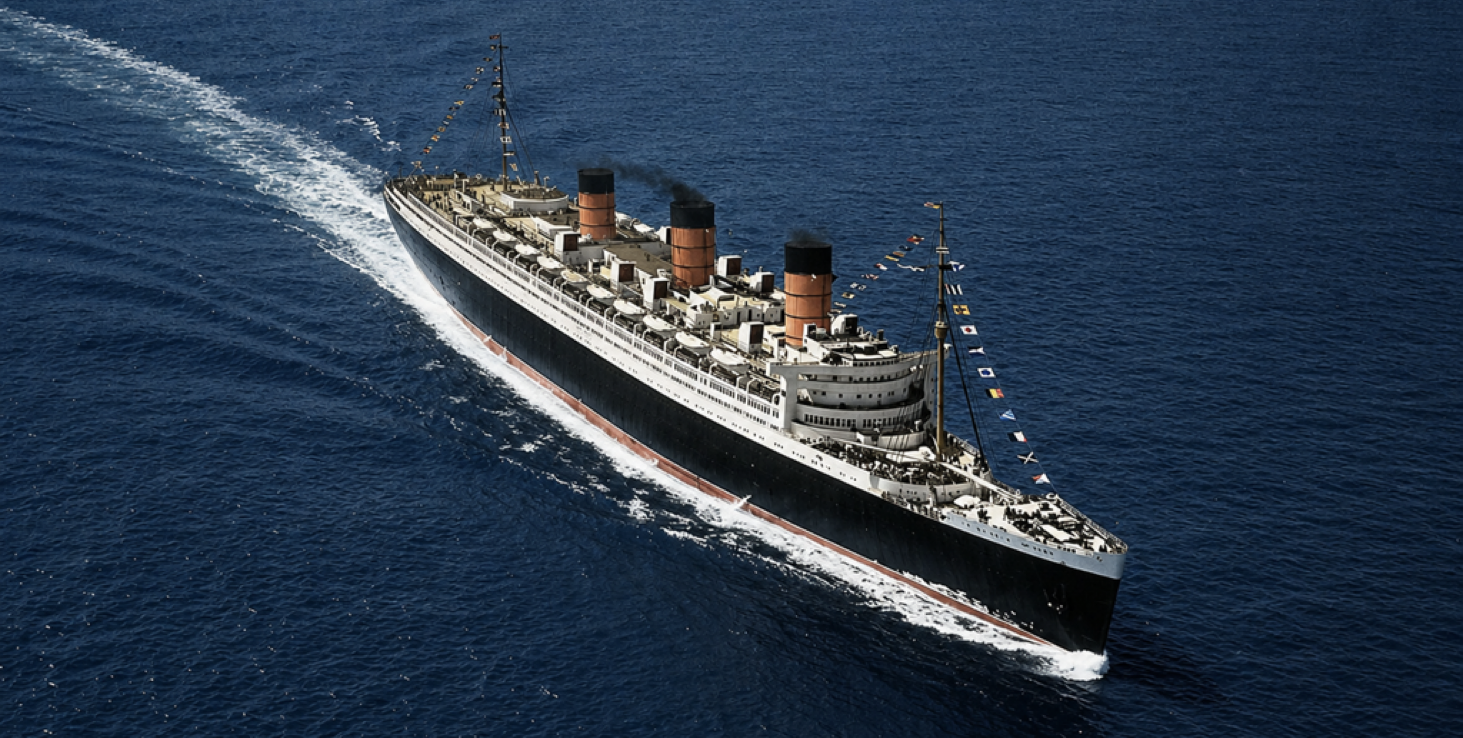
This page is a focused chronology rather than a full interpretive essay. It follows
RMS Queen Mary
from her Clydebank construction and 1936 entry into service, through Blue Riband competition, wartime troopship conversion, postwar Atlantic service, commercial decline, final voyage, and preservation at Long Beach.
Date note: some milestones are exact launch, maiden voyage, record, arrival, or retirement dates. Other entries are best understood as operating phases, especially around wartime conversion, postwar service patterns, and the slow loss of transatlantic passenger demand.
Identity note: Queen Mary’s meaning changes repeatedly. She begins as a Cunard prestige liner, becomes a high-capacity wartime transport, returns as a postwar Atlantic flagship, and finally becomes a preserved historic ship.
Filters
Toggle categories to narrow the page by construction, record-setting, war service, passenger service, or retirement and preservation.
⌕
Tip: Search matches section, date, title, description, and category tags.
Work begins on Cunard’s Hull 534 at John Brown & Company
Construction
The future Queen Mary takes shape at Clydebank as Cunard’s answer to the next generation of North Atlantic express liners. At this stage she is still known by yard number rather than by her royal name.
1931–1934
Construction is halted during the Depression
Construction
Financial pressure interrupts the project, leaving the unfinished hull as a visible symbol of both ambition and economic crisis. The ship’s later success should be read against this difficult beginning.
Curator note
Queen Mary was not simply “inevitable.” Her completion depended on a changed financial and corporate situation, including the merger that produced Cunard White Star.
1934
Work resumes under Cunard White Star
Construction
The liner project moves forward again after government support and corporate restructuring. The ship now belongs to a broader effort to restore British competitiveness on the premier North Atlantic route.
26 September 1934
Launch of Queen Mary
Construction
The ship is launched and publicly named Queen Mary. The ceremony transforms Hull 534 from a technical project into a national symbol of recovery, prestige, and maritime confidence.
1935–1936
Fitting out and trials prepare the liner for service
Construction
Interiors, machinery, passenger spaces, and operating systems are completed. This is the phase where the ship becomes more than a hull: she becomes a working Atlantic liner with a carefully staged public identity.
27 May 1936
Queen Mary departs Southampton on her maiden voyage
ConstructionPassenger service
The liner enters transatlantic service between Southampton, Cherbourg, and New York. Her debut places her directly into the prestige contest among Britain, France, Germany, and Italy on the North Atlantic.
1936–1939 · Blue Riband rivalry and prewar prestige
Summer 1936
Early service establishes the ship’s Atlantic profile
Passenger service
Passenger service quickly turns the ship into one of Britain’s most visible maritime symbols. Speed, scale, interior design, and reliability all shape her early reputation.
August 1936
Queen Mary wins the Blue Riband from Normandie
RecordsPassenger service
The liner captures the speed record for the North Atlantic, strengthening her public identity as a technological and national achievement. The rivalry with Normandie becomes one of the defining ocean liner stories of the late 1930s.
1937
Normandie retakes the record
RecordsPassenger service
The French liner’s renewed claim keeps the rivalry alive. The exchange matters because it shows how speed records were also publicity instruments, not merely technical footnotes.
August 1938
Queen Mary regains the Blue Riband
RecordsPassenger service
Queen Mary’s 1938 record reinforces her claim as one of the fastest and most important liners of her era. In later memory, this achievement becomes inseparable from her interwar identity.
1938–1939
Late prewar service under growing political tension
Passenger service
Queen Mary continues scheduled service as Europe moves toward war. Her luxury-liner identity remains intact, but the world that created it is about to be interrupted.
1939–1946 · Wartime conversion and troopship service
September 1939
War interrupts normal Atlantic passenger service
War service
With the outbreak of the Second World War, the ship’s normal commercial role ends. Her speed and size make her too valuable to remain simply a passenger liner.
1940
Conversion for troopship duty
War service
Luxury fittings and passenger routines give way to wartime transport needs. The famous grey wartime appearance and high-capacity troop configuration become part of the ship’s second identity.
1940–1945
High-speed Allied troop transport
War service
Queen Mary carries enormous numbers of military personnel during the war. Her speed helps her operate with reduced vulnerability compared with slower ships, while her capacity makes her strategically valuable.
2 October 1942
Collision with HMS Curacoa
War service
While on wartime service, Queen Mary collides with the escorting cruiser HMS Curacoa, which sinks with heavy loss of life. The event is one of the most serious and somber episodes in the ship’s career.
Curator note
This entry should be handled carefully. It is not a “liner trivia” moment, but a wartime disaster involving loss of life and operational secrecy.
1945–1946
Repatriation and transition out of troopship use
War service
After the war, the ship helps move personnel home and then begins the transition back toward civilian service. The postwar liner that emerges is connected to the 1930s ship, but not untouched by war.
1947–1967 · Postwar service, jet-age pressure, and withdrawal
1947
Queen Mary returns to peacetime passenger service
Passenger service
After refitting, Queen Mary resumes civilian transatlantic work. Together with Queen Elizabeth, she forms the core of Cunard’s postwar express service.
Late 1940s–1950s
The two-Queens service defines Cunard’s postwar Atlantic image
Passenger service
The paired operation of Queen Mary and Queen Elizabeth gives Cunard a powerful postwar identity: regularity, speed, capacity, and prestige across the North Atlantic.
1950s
A mature Atlantic liner in changing travel culture
Passenger service
Queen Mary remains glamorous, but the context around her changes. Air travel grows more competitive, and ocean liners increasingly have to justify themselves beyond speed and prestige alone.
1960s
Jet-age economics erode the liner’s commercial future
Passenger serviceRetirement
The rise of transatlantic air travel sharply reduces the need for express ocean liners. Queen Mary’s prestige remains strong, but prestige alone cannot protect an aging, expensive ship indefinitely.
1967
Sale to Long Beach, California
Retirement
The ship is sold for preservation and reuse rather than scrapping. This decision separates Queen Mary from many other famous liners whose careers ended at the breakers.
31 October 1967
Final commercial departure from Southampton
Passenger serviceRetirement
Queen Mary leaves Southampton for the last time as an operating liner. The departure marks the emotional end of her Atlantic career, even though her physical life will continue.
9 December 1967
Arrival at Long Beach
Retirement
The ship reaches her permanent home in California. Her story now shifts from working ocean liner to preserved attraction, hotel, museum environment, and contested historic object.
1967–present · Preservation, adaptation, and public memory
Late 1960s–1970s
Conversion from liner to visitor destination
Retirement
Queen Mary is adapted for static use at Long Beach. The work preserves the ship physically, but also changes spaces, removes some working-ship context, and complicates later interpretation.
1970s–1990s
A preserved liner becomes a layered public attraction
Retirement
The ship develops multiple identities at once: historic artifact, hotel, event venue, tourist attraction, and pop-culture setting. Those layers help explain both her survival and the interpretive challenges around her.
2000s–present
Preservation concerns and renewed heritage attention
Retirement
As an aging steel ship in static preservation, Queen Mary requires continuing maintenance, interpretation, and funding attention. Her survival is extraordinary, but it is not self-sustaining.
Curator note
A strong Queen Mary page should avoid treating preservation as a simple happy ending. Long-term static preservation is itself a complex historical phase.
Today
Queen Mary remains one of the most important surviving ocean liners
Retirement
Unlike most great liners of the classic transatlantic age, Queen Mary still exists. That survival makes her a rare physical bridge between shipbuilding, passenger culture, wartime transport, and modern preservation.
Continue Exploring Queen Mary
Use the timeline as the backbone, then move outward into wartime service, interiors, design, and ship-guide reference material.