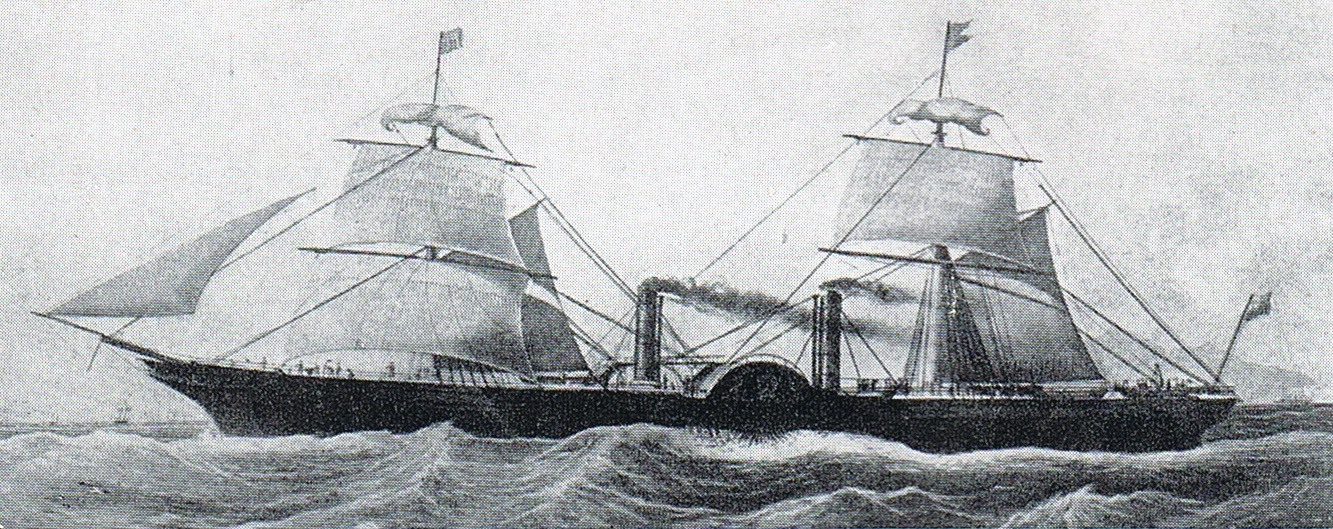
RMS Persia
Cunard Line · 1855 / 1856 · Ship Guide
Overview
RMS Persia was one of the great mid-Victorian Cunard paddle liners: an iron-hulled Atlantic mail steamer of exceptional size and prestige, launched in 1855 and entering service in 1856 on the Liverpool–New York route. She belongs to the high-performance paddle era that followed the first generation of smaller Cunard mail steamers and preceded the full dominance of the screw-propelled express liner. In that sense, Persia should be understood not as an early experimental steamer, but as a highly developed prestige liner that brought the Atlantic paddle type close to its maximum refinement.
In interpretation, Persia is important both as Cunard’s first iron-hulled transatlantic liner and as a record-breaking paddle steamer whose importance lies in scale, performance, and transition.
Key Facts
Nineteenth-century ship figures often vary somewhat between sources depending on whether they report commercial summary measurements, strict registry figures, hull breadth versus overall width, or contemporary descriptive journalism. For cataloging, it is best to preserve the wording and units used by the cited source.
Design & Construction Context
Persia was built in response to the intense Atlantic competition of the 1850s, especially the challenge posed by the Collins Line. Cunard had already learned that simply forcing more power into large wooden paddle ships had structural limits. With Persia, the line moved decisively into iron-hull construction, producing a vessel that contemporary observers described as the largest steamship afloat and one of the most impressive merchant steamers of her time.
She therefore marks an important threshold in liner history. Visually, she still belonged to the great Atlantic paddle-steamer world, with large side wheels and a pronounced paddle-liner profile. Structurally and operationally, however, she points forward toward a larger and more ambitious age of Atlantic steamship design. She is best understood as a culminating prestige paddle liner, not as a merely oversized survivor of an older form.
Service History (Summary)
1855 launch: Persia was launched in July 1855 by Robert Napier & Sons at Glasgow. Her launch attracted substantial attention because of her exceptional size and because she represented Cunard’s move into major iron-hulled Atlantic construction.
1856 maiden voyage: Her first crossing began on 26 January 1856 from Liverpool to New York. During that maiden voyage she reportedly struck ice, but the strength of her construction helped prevent catastrophe.
1856 Blue Riband achievement: Within months of entering service, Persia captured the Atlantic speed record in both directions. This matters interpretively because it shows that the paddle liner, even in an era increasingly pointing toward the screw steamer, could still represent the cutting edge of Atlantic prestige and performance.
Mid-1850s to 1860s Cunard service: Persia served on Cunard’s premier Liverpool–New York route and stood among the line’s most important passenger and mail ships. She was not a later immigrant mega-liner or Edwardian floating palace; her importance lies in mid-Victorian express service, scale, and engineering ambition.
1861 troop transport episode: During the Trent Crisis, Persia was among the liners chartered to help move troops toward British North America. This wartime or emergency-use episode should be treated as distinct from her primary Atlantic passenger and mail identity.
Obsolescence in the screw era: Although still impressive, Persia was burdened by the inefficiencies of large paddle propulsion. As Cunard introduced more profitable screw mail liners, she became harder to fit into the company’s evolving service structure.
1868 withdrawal and 1872 scrapping: She was laid up in 1868, her engines were removed, and an intended conversion did not proceed. She was ultimately broken up in 1872, ending the career of one of Cunard’s most important paddle liners.
Interpretive Notes
This is a major prestige paddle liner, not a primitive early steamer: Persia belongs to a later and much more advanced phase than the first Cunard mail packets of the 1840s.
Her iron hull is central to her significance: she marks Cunard’s important move away from the structural limitations of large wooden paddle steamers and toward a more ambitious construction standard.
Her Blue Riband record should be taken seriously: the speed achievement helps explain why she mattered in her own moment. Persia was not simply large; she was also competitive at the highest Atlantic level.
She represents a transition rather than a dead end: although paddle propulsion would soon be eclipsed, Persia shows how powerful and sophisticated that branch of liner development could become before screw propulsion finally took command of the main Atlantic express routes.
Her short service life reflects technological change, not insignificance: being outclassed within little more than a decade does not diminish her importance. Instead, it highlights how rapidly Atlantic steamship technology was changing in the mid-nineteenth century.
Evidence-first ship guideSources (Selected)
- Ocean Liner Curator — Sources (master bibliography)
- Norway Heritage — Persia summary, launch date, maiden voyage, dimensions, and later disposal notes
- RMS Persia — general summary of service history, Blue Riband context, and major characteristics
- GG Archives — Cunard fleet listing context
- Norway Heritage — Cunard fleet and route context