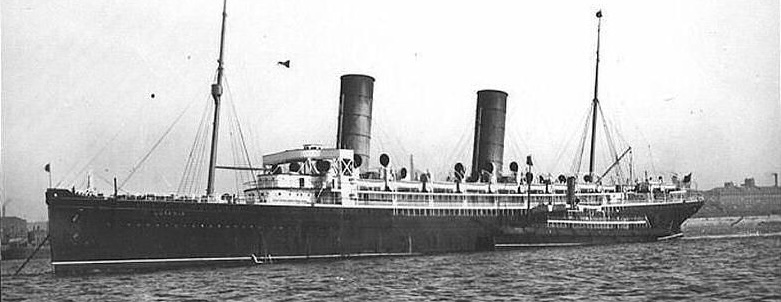
RMS Lucania
Cunard Line · entered service 1893 · Ship Guide
Overview
RMS Lucania was the younger sister of Campania and the faster of Cunard's great 1890s express pair. Fairfield Shipbuilding & Engineering at Govan launched her on 2 February 1893, and she entered Liverpool–New York service on 2 September that year.
Her significance extends beyond speed. Lucania combined the peak of large reciprocating-engine technology with richly Victorian passenger spaces and, in 1901, became the first Cunard liner fitted with Marconi wireless. She therefore stands at the intersection of mature nineteenth-century engineering and the communications revolution that would reshape twentieth-century ocean travel.
Key Facts
The Peak of Reciprocating Express Technology
Lucania and Campania represented the culmination of a technology refined over decades. Their five-cylinder triple-expansion engines were enormous, complex machines built to extract high power from reciprocating steam propulsion just before turbines began to change the engineering basis of fast passenger ships.
This makes Lucania a hinge ship. She was not technologically obsolete when built; she was among the most advanced liners afloat. Yet within little more than a decade, turbine-driven ships such as Lusitania and Mauretania would redefine what “modern” meant.
A Sister-Ship System
The sisters are best understood together. Cunard needed more than one spectacular vessel to sustain an express timetable, and the pair allowed the company to offer regular high-speed service rather than sporadic record attempts.
Their closeness also creates an attribution challenge. Photographs, postcards, and unlabeled illustrations can be difficult to assign confidently, especially when they show broadside views without readable names. Date, photographer, published caption, and small structural details matter.
Victorian Passenger Spaces
Royal Museums Greenwich preserves imagery of Lucania's first-class dining saloon, an Italianate room with a white-and-gold coffered ceiling, Ionic columns, and Cunard insignia worked into the furniture. Such interiors show how the liner functioned simultaneously as an industrial machine and a carefully designed social environment.
The room also belongs to a specific historical style. Later liners are often remembered for increasingly theatrical architecture, but Lucania's spaces still drew heavily on Victorian hotel, club, and domestic design conventions.
Record Crossings
Lucania repeatedly improved transatlantic passage times during the mid-1890s and held major eastbound and westbound records. These achievements were engineering results, marketing tools, and national prestige events all at once.
They should nevertheless be described carefully. Direction and voyage date matter, and the familiar “Blue Riband” language can suggest a degree of formalization that did not always exist in contemporary practice.
Wireless Changes the Passenger Experience
In 1901 Lucania became the first Cunard liner fitted with Marconi wireless. The innovation did more than improve operational safety. It began changing the psychological experience of a crossing by making the ship less isolated from events ashore.
News, ship-to-ship communication, operational messages, and eventually passenger communications all grew out of this technological shift. For curatorial work, wireless-era material belongs to a later operational phase than early-1890s imagery.
Final Years and the 1909 Fire
By the early twentieth century Lucania was no longer Cunard's newest technological statement, but she remained an important and recognizable liner. On 14 August 1909, while at Liverpool, a severe fire gutted the ship.
The hull and machinery survived well enough for removal, but the damage ended her career. The loss came at a moment when Cunard's turbine giants had already changed the competitive landscape, making the fire both an abrupt ending and a symbolic close to the reciprocating express generation.
Passenger Culture Beyond First Class
Although first-class interiors dominate the surviving visual record, Lucania's commercial success depended on a much broader passenger mix. Second- and third-class travelers formed a substantial part of the ship's capacity, linking the express service to migration and ordinary transatlantic mobility as well as elite travel.
This broader social context matters when interpreting surviving objects. A first-class dining-room photograph documents one world aboard ship, while a third-class passenger list, ticket, or baggage label documents another. Both are necessary to understand the liner as a functioning transport system.
Why Speed Mattered Commercially
Record passages were not simply sporting achievements. A faster crossing improved timetable reliability, reduced journey time, generated press coverage, and advertised both Cunard and British marine engineering. The publicity value could be enormous even when the practical difference between one record and the next was relatively small.
That commercial function helps explain why speed became so central to the sisters' public image. It was engineering performance converted directly into brand reputation.
Collecting and Attribution
Because Lucania and Campania were closely related, unlabeled postcards and photographs can be difficult to identify. Printed captions are useful but not infallible, and later reproductions may repeat earlier mistakes. Strong attribution uses multiple clues: date, photographer, port, configuration, and contemporary captioning.
Wireless-era material adds another layer. A photograph or brochure from after 1901 may reflect equipment and operational practices absent from the ship's first years, so the career should not be treated as visually static.
Interpretive Notes
Lucania's importance lies in the combination of speed, machinery, interiors, and communications technology. Treating her only as a record ship misses much of what she represents.
For attribution, the sister relationship with Campania demands caution. Printed name, dated voyage context, and provenance are stronger evidence than silhouette alone.
Evidence-first ship guide