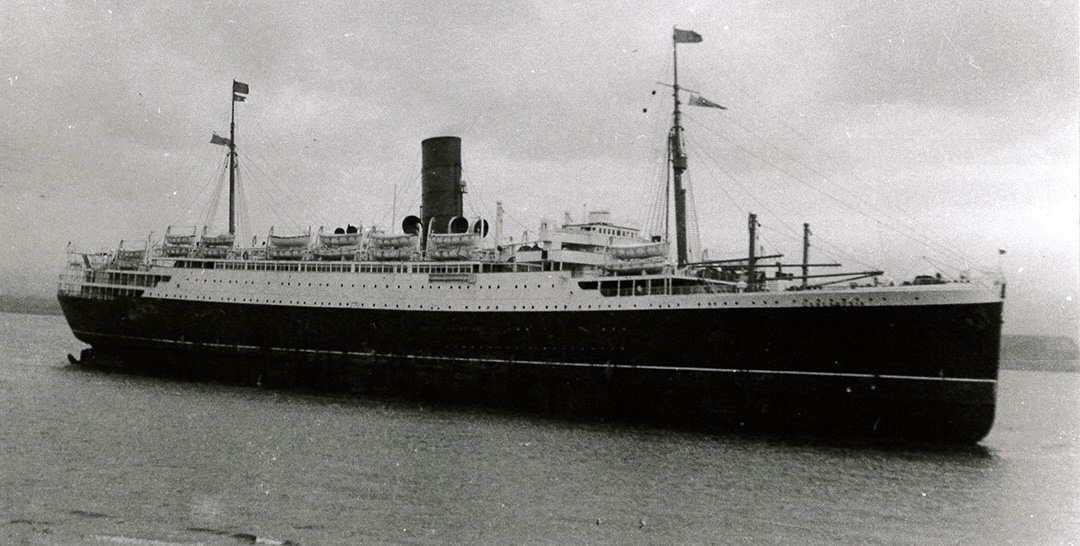
RMS Lancastria
Anchor Line (Cunard) · 1920 · Ship Guide
Overview
RMS Lancastria began life as RMS Tyrrhenia, launched on the River Clyde in 1920 for the Anchor Line (a Cunard-associated company). In peacetime she worked the North Atlantic in the “intermediate” lane—useful capacity, dependable schedules, and the mixed passenger-and-cargo economics that kept many interwar liners afloat.
Her name is inseparable from June 1940. Requisitioned for wartime transport service (often cited as HMT Lancastria in this phase), she was ordered into the evacuation traffic from western France during Operation Aerial. On 17 June 1940, while crowded at anchor off St. Nazaire, she was attacked from the air and sank rapidly.
Evidence-first note: the scale of the loss is well established, but precise totals are not. Wartime loading was chaotic, manifests were incomplete, and later accounts often conflate “on board,” “embarked,” “rescued,” and “missing.” Treat any single-number death toll as an estimate, and show your source.
Key Facts
Note on terminology: “RMS” reflects her mail-ship identity in peacetime contexts; wartime transport references often use “HMT.” When cataloging objects or photos, match the label to the date and documentary context.
Design & Construction (Context)
Tyrrhenia/Lancastria belongs to the interwar working-liner class—ships designed to make money in mixed conditions rather than to chase headline speed. What collectors often miss is how “ordinary” ships generate the most documentary confusion: fewer glossy souvenir books, more routine paperwork, and less consistent photographic coverage than the famous record-holders.
For provenance work, the ship’s most important boundary is 1924 (renaming/refit context) and then the abrupt boundary of June 1940 (wartime transport service and loss). A postcard captioned “Lancastria” can be correct in one decade and misleading in another if it is actually showing her as Tyrrhenia—or if the image is a retouched stock view reused across years.
Service History (Summary)
1920–1924: Built and introduced as Tyrrhenia. Launched in 1920 and entering service in 1922, she worked the Atlantic on routes commonly summarized as Glasgow–Quebec–Montreal (and related rotations).
1924–1939: Cunard/Anchor Line service as Lancastria. Renamed in 1924, she continued in North Atlantic employment and later appears in many summaries as a cruise ship in the 1930s. This interwar period is where most surviving peacetime ephemera clusters: menus, postcards, printed sailing lists, baggage labels, and onboard stationery.
1939–June 1940: Requisition and transport work. With war, liners were folded into military logistics—often refitted, repainted, and stripped of peacetime fittings as priorities shifted to capacity, speed of embarkation, and operational utility.
17 June 1940: St. Nazaire and the sinking. During Operation Aerial, Lancastria embarked a dense and mixed crowd: British service personnel, RAF staff, support troops, civilian refugees, and other evacuees. While anchored off St. Nazaire, German air attack struck the ship. She sank in a short time-window, producing the single hardest evidentiary problem in her story: how many were actually on board.
Evidence-first note: contemporary suppression and later retellings can distort chronology and numbers. If you publish a death-toll figure, present it as “estimated” and pair it with the method (survivors counted, bodies recovered, official lists, later archival reconstruction, etc.).
Operation Aerial in Precise Context
The sinking occurred during Operation Aerial, the evacuation of British military personnel and civilians from western France after Dunkirk. On 17 June 1940 Lancastria was anchored off Saint-Nazaire carrying a vastly overloaded and incompletely documented complement when German aircraft attacked.
The British Ministry of Defence describes the ship as having sunk within about twenty minutes after being bombed by a Ju 88. More than 3,000 deaths are officially acknowledged, while many historical estimates are higher because the embarkation process had overwhelmed normal manifest controls.
Why the Casualty Total Remains Uncertain
The uncertainty is not a minor bookkeeping problem. Troops, RAF personnel, embassy staff, civilians, and refugees were embarked rapidly under evacuation conditions, and normal passenger-list procedures did not survive the emergency. Surviving totals therefore depend on incomplete records, survivor testimony, unit returns, and later reconstruction.
For curatorial work, the responsible approach is to distinguish the documented minimum from wider estimates rather than repeating a single dramatic number as settled fact.
Interpretive Notes
1) The number problem is the story. Unlike peacetime sailings with passenger lists and routine accounting, the St. Nazaire embarkation was emergency-driven. People were directed aboard by circumstance, not by ticketing. For collectors and researchers, that means “my relative was on Lancastria” is often based on family memory plus fragmentary paperwork—still meaningful, but not always machine-verifiable.
2) “Forgotten” is partly structural. The sinking sits in the shadow of broader June 1940 events. Add in the way wartime information was managed, and you get a case where public awareness lagged behind the scale of the tragedy. When you write about this ship, avoid dramatizing the “cover-up” frame unless you anchor it to documents and dated policy context.
3) Collecting ethics. Artifacts connected to the loss—lifeboat fittings, “recovered from the wreck” claims, or unprovenanced relics—are an area where restraint matters. Prioritize documentation, chain-of-custody, and clear labeling of uncertainty.
Evidence-first ship guideSources (Selected)
Starting points for chronology and the evidentiary issues around totals. Corroborate publish-ready specifics (especially casualty estimates and embarkation claims) with archival material and dated records.
- Ocean Liner Curator — Sources (master bibliography)
- The National Archives — “Forgotten tragedy: The loss of HMT Lancastria”
- Royal Museums Greenwich — “Sinking of the Lancastria, 17 June 1940” (collection record)
- BBC — “Lancastria: the forgotten tragedy of World War Two”
- Wikipedia — RMS Lancastria (starting index; corroborate key facts)
- U.S. Naval Institute (Naval History) — “The Sinking of the Lancastria”
- UK Ministry of Defence — 75th anniversary account of HMT Lancastria