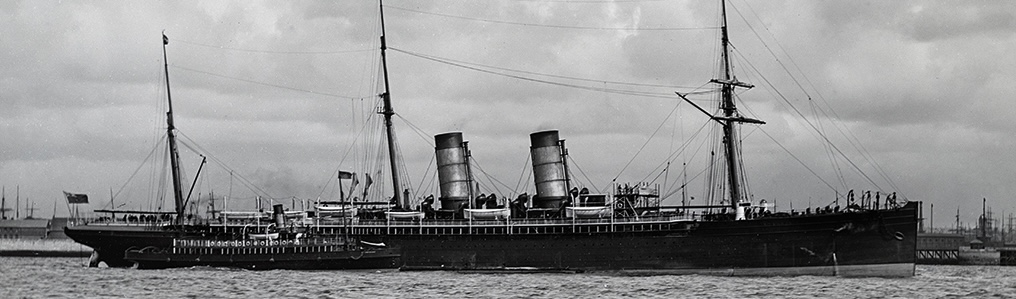
RMS Etruria (1884)
Cunard Line · launched 1884 · Ship Guide
Overview
RMS Etruria was one of Cunard’s principal express liners of the mid-1880s and the near-identical sister of Umbria. John Elder & Co. at Glasgow built her as yard no. 286; she was launched on 20 September 1884, completed in March 1885, and began her maiden voyage from Liverpool to New York via Queenstown on 25 April 1885.
The previous guide contained several important technical errors. Etruria was not a twin-screw liner and her yard number was not 359. She was driven by a three-cylinder compound engine turning a single screw, while three masts carried auxiliary sail. That combination makes her and Umbria especially evocative transitional ships: highly competitive steam express liners that still retained a working relationship with sail.
Within months of entering service, Etruria was making record Atlantic passages. Her speed achievements, repeated in 1888, place her firmly in the competitive sequence that preceded Cunard’s later Campania and Lucania.
Key Facts
Design at the End of the Sail-Assisted Era
Etruria and Umbria were among the last Cunard liners fitted with auxiliary sails. Their three-masted rigs were not simply decorative historical references: with only one propeller shaft, sail retained value as supplementary power and as an emergency resource. The survival of sail aboard ships capable of roughly 19 knots captures the overlap between old and new technologies better than a simple “steam replaced sail” narrative.
They were also large, steel-hulled express ships built for the prestige end of Cunard’s North Atlantic service. Refrigerating machinery, large passenger spaces, and increasingly modern communications later in the career sat alongside engineering choices that would soon be superseded by twin screws and more advanced engines.
Record Passages
In August 1885, only months after her maiden voyage, Etruria made record crossings in both directions. Contemporary Blue Riband chronologies credit an eastbound passage of about 6 days 9 hours and a westbound passage of about 6 days 5 hours 31 minutes. She improved the westbound mark again in 1888, while her sister Umbria was an immediate competitor within Cunard’s own fleet.
These records should be understood as measured operational performance rather than as an official trophy awarded by a governing body. “Blue Riband” is a retrospective convention used to describe the fastest recognized Atlantic passages of the period.
Later Service and Mishaps
1901: Etruria was fitted with wireless, extending her career into the new communications era.
February 1902: her propeller shaft failed in the Atlantic, leaving a single-screw liner without powered propulsion. Distress rockets brought the Leyland Line steamer William Cliff to her assistance. Sail was set and towing arrangements made toward the Azores; passengers and mail were later transferred while Etruria underwent repair.
Later in 1902: further shaft trouble again forced repairs, demonstrating the vulnerability inherent in relying on a single propeller shaft even on a prestigious express liner.
1903: after an early-year grounding near New York, Etruria was struck by a severe wave in October. Part of the forward bridge was damaged and one passenger was killed.
1908–1910: damage during her final period of service led to withdrawal in 1908. She was subsequently sold to shipbreakers and dismantled at Preston around 1909–10; sources differ slightly in whether the scrapping date is assigned to arrival, sale, or completion of breaking.
Interpretive Notes
Single screw matters: the machinery arrangement is central to understanding both the ship’s speed achievements and her later shaft emergencies. Describing her as twin-screw erases an important part of the design story.
Record-holder, not endpoint: Etruria was a major express liner, but the pace of technical change was rapid. By the 1890s, Campania and Lucania represented a new Cunard generation; by the 1900s, turbine ships transformed the competitive landscape again.
Auxiliary sail is evidence of overlap: her rig should not be interpreted as evidence that steam was still secondary. Steam was the basis of schedule and performance, while sail remained a useful supplementary and emergency system.
Evidence-first ship guide