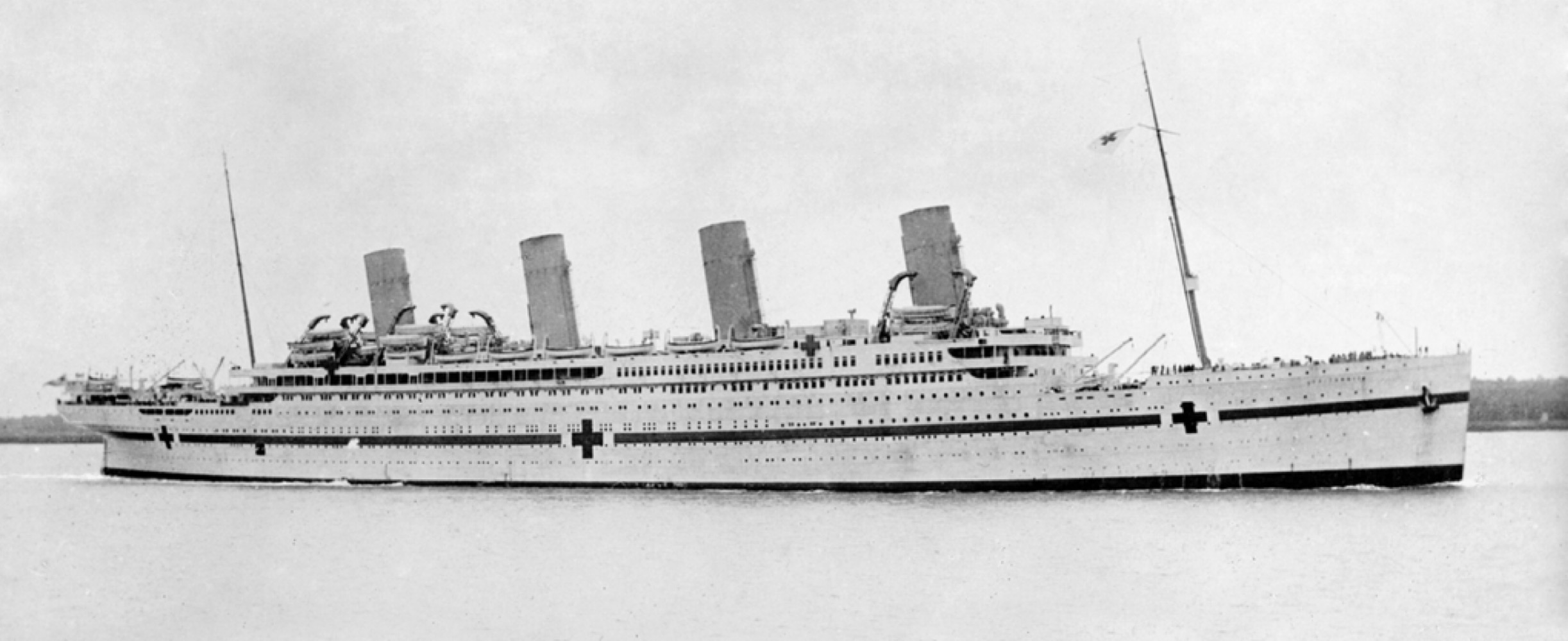
RMS Britannic was the third and final Olympic-class liner built for the White Star Line—designed as a larger, improved sister to
RMS Olympic and RMS Titanic. She was launched in 1914, but the First World War intervened before she could enter
peacetime passenger service.
Completed during wartime, she entered service as a hospital ship (HMHS Britannic) in late 1915 and sank in the Aegean Sea on
21 November 1916 after striking a naval mine. In collector terms, this creates a distinctive profile: immense public fame, but a comparatively
narrow window for ship-specific commercial material.
This page is written as a reference doorway: it summarizes widely documented facts, flags uncertainty where it exists,
and avoids turning repeated anecdotes into “record” without evidence.
Bridge page
Why HMHS Britannic Matters
A reader-friendly explanation of why Britannic matters beyond being Titanic’s sister ship.
Key Facts
Operator (as built / intended)
White Star Line (commercial passenger service planned, but not realized)
Wartime service
Hospital ship (HMHS Britannic) under British government / Admiralty control
Builder
Harland & Wolff (Belfast, Ireland)
Yard number
433 (commonly cited)
Laid down
November 30, 1911
Launched
February 26, 1914
Completed
December 1915 (wartime completion)
Maiden voyage
No peacetime passenger maiden voyage; first operational voyages were as a hospital ship (late 1915)
Primary route (wartime, typical)
Mediterranean hospital ship runs (often associated with Southampton ↔ Mudros via Naples; ports varied)
Tonnage
48,158 GRT (widely cited)
Length / Beam
~882 ft / ~94 ft (commonly cited; measurement conventions vary)
Propulsion
Triple-screw steam plant (reciprocating engines for wing shafts + low-pressure turbine for center shaft)
Notable distinction
Among the largest ships lost during World War I (by tonnage), with a comparatively low death toll due to rapid evacuation
Service period
1915–1916 (wartime service only)
Fate
Sank November 21, 1916 after striking a naval mine near Kea (Aegean Sea)
Note on naming: “RMS Britannic” is commonly used to describe the ship as designed and intended for commercial service, while “HMHS Britannic”
describes her documented operational career.
Design & Construction (Context)
Britannic sits at the “post-Titanic” design moment: she is often discussed through the lens of safety revisions and lessons learned.
Some improvements are well documented (e.g., changes in subdivision and lifeboat arrangements), while other claims are frequently repeated in simplified
form without careful sourcing.
For collectors, the key structural reality is simple: because she did not run regular civilian Atlantic crossings, the usual ecosystem of abundant
passenger-ship ephemera (menus across seasons, souvenir booklets across years, baggage labels from multiple routes, etc.) does not exist at the same scale.
When items do appear as “RMS Britannic,” the burden of evidence rises.
Cut-away Views & General Arrangement
These two illustrations provide a visual guide to RMS/HMHS Britannic’s internal arrangement and the
relationship between her passenger spaces, hospital-ship conversion, machinery, and revised safety features.
Select either image to open a larger, viewport-aware view.
General arrangement · Part 1
Forward section
The first view shows the forward portion of the ship’s arrangement, helping relate passenger decks,
public spaces, service areas, hull subdivision, and the structural changes introduced after the loss of
Titanic.
General arrangement · Part 2
Aft section
The second view continues through the after portion of the ship, completing the visual record of cabins,
service spaces, machinery, lifeboat arrangements, and the ship’s broader internal organization.
Curatorial note: Plans and sectional drawings may represent Britannic as designed for
passenger service, as completed, or after conversion to a hospital ship. Treat room names, fittings, and
arrangements as configuration-specific unless the illustration clearly identifies its date and purpose.
Service History (Summary)
Launched in early 1914, Britannic was still fitting out when war began later that year. She was completed during wartime and entered service as a
hospital ship in December 1915, operating in the Mediterranean in support of Allied medical evacuation and care.
On the morning of 21 November 1916, she struck a mine in the Kea Channel and sank within the hour. Although most aboard survived, a number of deaths occurred,
including fatalities associated with lifeboats encountering still-turning propellers during the evacuation.
Later History & Wreck “Afterlife”
The wreck of Britannic has been located since the 1970s and has an active documentation history through expeditions, filming, and technical diving.
That visibility is a double-edged sword for collecting: it creates legitimate, documentable objects and narratives, but also invites vague “wreck recovered”
claims that may be impossible to verify.
Ocean Liner Curator treats “from Britannic” claims the way it treats all high-value provenance assertions: look for credible documentation,
detailed match points to period photographs, conservation context, and a traceable chain of custody. When those are absent, responsible labels include
“attributed,” “reported,” or “unverified.”
Designed After Titanic
Britannic was not simply a third copy of Olympic and Titanic. Changes made during construction after the 1912 disaster included more extensive watertight subdivision and altered lifeboat arrangements, including the prominent gantry davits that distinguish her later appearance.
Those changes make her especially useful for comparative study, but they also mean that Britannic should not be used uncritically as a stand-in for Titanic. Similarity and post-1912 modification have to be considered together.
Hospital Ship Rather Than Passenger Liner
The war prevented Britannic from ever entering the commercial service for which she had been designed. Instead, she was completed and fitted for hospital-ship work, with wards, medical spaces, and wartime markings replacing the peacetime passenger identity White Star had intended.
This is the central curatorial boundary for the ship: proposed passenger interiors and company publicity document an unrealized future, while photographs and surviving operational records document HMHS Britannic as a wartime medical transport.
The 21 November 1916 Loss
Britannic struck a mine in the Kea Channel on 21 November 1916 and sank in less than an hour. The relatively low loss of life compared with Titanic reflected both the wartime operating context and the fact that the ship was not carrying a full complement of patients at the time.
Later wreck exploration has made Britannic unusually important for physical evidence, but archaeological observations should still be separated from contemporary wartime records when reconstructing the sequence of damage and sinking.
Interpretive Notes
Britannic is frequently framed as “the improved Titanic,” which can be directionally true while still flattening the historical record.
The ship that exists in documentation is a wartime medical platform with a short operational life—not a fully realized commercial passenger liner with a long
service arc.
For evidence-first collecting, the practical takeaway is classification discipline: many authentic items tied to Britannic will be “hospital ship era”
in language, markings, and context. An item marketed as “RMS Britannic (White Star Line)” should be expected to carry unusually strong supporting
evidence, because the normal channels for routine passenger ephemera never fully materialized.