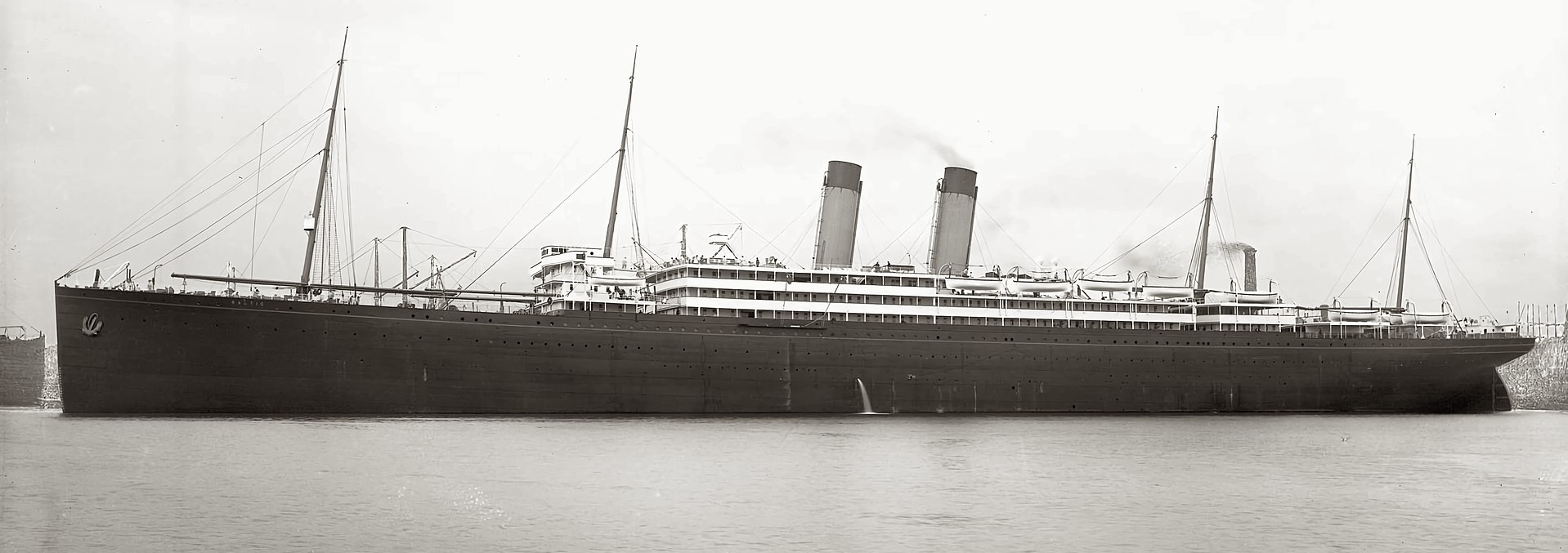
RMS Baltic
White Star Line · entered service 1904 · Ship Guide
Overview
RMS Baltic was the third of White Star Line's “Big Four,” built by Harland & Wolff at Belfast as yard no. 352. Larger than Celtic and Cedric, she continued White Star's strategy of very large, moderate-speed passenger-and-cargo ships rather than express liners.
Her long career is especially notable for the January 1909 Republic rescue. Wireless communication enabled Baltic to locate the stricken ships in fog, after which survivors were transferred aboard her. The episode became one of the clearest early demonstrations of wireless telegraphy's value at sea.
Key Facts
Development of the Big Four
Baltic was longer and heavier than her two predecessors while retaining the same basic commercial philosophy and reciprocating machinery. Harland & Wolff recorded twin quadruple-expansion engines, eight double-ended boilers and a service speed of about 16 knots.
Her scale temporarily made her one of the world's largest passenger ships. The significance lies less in the record itself than in how quickly White Star was expanding the capacity of its Atlantic fleet before the turbine age and the Olympic class.
The Republic Rescue, 1909
On 23 January 1909 the White Star liner Republic was rammed by the Italian liner Florida in dense fog near Nantucket. Republic lost normal power, but wireless operator Jack Binns transmitted a CQD distress call using the remaining battery supply. The signal was relayed and ultimately reached Baltic.
Baltic spent hours searching through the fog before reaching the disabled vessels. Survivors who had already been transferred from Republic to Florida were moved again to Baltic. Six people died as a direct result of the collision, but the surviving passengers and crews were brought to safety. The episode belongs to the history of both ships: Republic demonstrated the practical value of wireless distress communication, while Baltic provided the principal rescue platform.
War and Later Service
During the First World War Baltic was used as a troopship and survived the conflict, including an encounter with a submarine in which she escaped serious damage. She resumed White Star's Liverpool–New York service after the war.
Her later career retained a rescue dimension. In December 1929, in severe weather off Newfoundland, Baltic rescued the crew of the schooner Northern Light; members of the rescue party were subsequently recognized for their actions.
Withdrawal
Baltic began her final transatlantic voyage in September 1932. By then the Big Four belonged to an earlier commercial world: migration patterns had changed, the Depression had reduced traffic, and newer liners offered machinery and accommodations conceived for a different era. Sold for scrap, she reached Osaka in February 1933.
Evidence-first ship guide