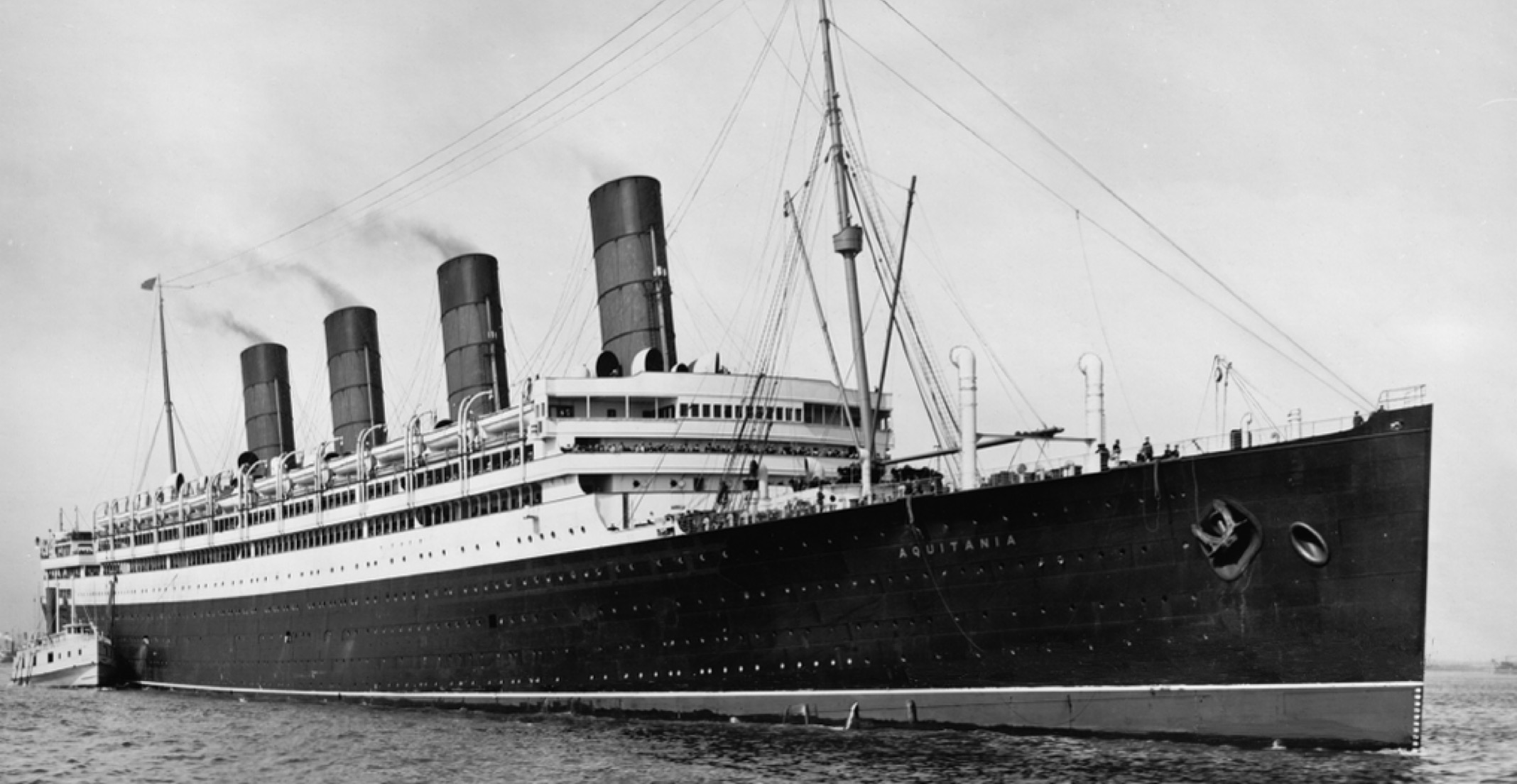
RMS Aquitania
Cunard Line · 1914 · Ship Guide
Overview
RMS Aquitania was built for Cunard as a four-funnel express liner and entered service in 1914. She became widely known as “the Ship Beautiful” for her interiors and public rooms, and her career ultimately spanned both world wars: requisitioned for military roles in World War I and later employed again as a troop transport during World War II.
This page is written as a reference doorway: it summarizes widely documented facts, flags uncertainty where it exists, and avoids turning later narrative into “record” without evidence.
A reader-friendly explanation of why Aquitania matters beyond Cunard prestige and longevity alone
Key Facts
Note on figures: passenger capacities, crew totals, and some machinery figures varied by era, refit, and wartime conversion. This guide treats exact totals as source-dependent and prefers builder or institutional documentation when quoting specifics.
Design & Construction (Context)
Aquitania belongs to the pre–World War I moment when national prestige, speed, and luxury were intertwined in North Atlantic competition. She was built at John Brown’s Clydebank yard (often listed as Yard No. 409) and designed with a four-funnel profile that visually aligned her with the era’s “great liners,” even though funnels could function as both exhaust uptakes and ventilation elements depending on arrangement.
A common interpretive trap: funnel-count is sometimes treated as a direct proxy for power or speed. In practice, funnel arrangements also served passenger-deck ventilation and public impression; treat simple “four funnels = fastest” claims as shorthand, not proof.
Sectional drawings: seeing Aquitania from the inside
These two cut-away views place Aquitania’s celebrated interiors within the ship’s complete architectural and mechanical system. They help show how public rooms, accommodation, circulation routes, service spaces, and machinery were layered through the hull.
Public rooms within the ship’s structure
This view connects Aquitania’s reputation as the “Ship Beautiful” with the practical arrangement surrounding her interiors. The public rooms were embedded within a working network of decks, passages, cabins, service areas, and structural spaces.
A complete liner arranged in layers
The second drawing emphasizes the scale of Aquitania’s internal organization. Passenger accommodation and ceremonial rooms existed alongside working zones and machinery, all coordinated within the narrow vertical and horizontal limits of the hull.
Why this matters: Interior photographs document the appearance of individual spaces, while sectional drawings reveal their relationships. Used together, they make Aquitania easier to understand as a complete ship rather than simply a collection of famous rooms.
Service History (Summary)
After entering service in 1914, Aquitania had only a brief peacetime start before World War I altered her trajectory. She was requisitioned and employed in military roles during the war, then returned to commercial service in the postwar years. In interwar service she became one of Cunard’s long-running Atlantic workhorses, operating on major routes that commonly included Southampton (and often Cherbourg) to New York, with variations across seasons and decades.
Wartime Service (High-level)
Aquitania is frequently noted for serving in both World War I and World War II—an unusually long operational span for a major express-era liner. Wartime conversions and assignments (armed merchant cruiser, hospital ship, troop transport) can be summarized easily, but the details matter: dates, routes, and configurations can differ by source and should be cited tightly if you’re making a precise claim.
Retirement & Scrapping (Summary)
After World War II, the ship continued in passenger-related service for a time (including transport-related voyages), but age, maintenance realities, and evolving safety standards made continued operation increasingly difficult. She was withdrawn from commercial service in 1949, and scrapped in 1950–51 at Faslane, Scotland.
Continuity Across Two World Wars
Aquitania's exceptional longevity is most visible in the fact that the same hull served through both world wars. In the First World War she was used in several military roles, including armed merchant cruiser, troop transport, and hospital-ship service at different stages. In the Second World War she again became a large-capacity troop transport.
Those wartime phases should be read as separate configurations rather than collapsed into a single “troopship” identity. Appearance, accommodation, markings, and operating context changed repeatedly as the ship moved between civilian and government use.
Postwar Service and the End of a Generation
After 1945 Aquitania returned once more to passenger and transport work, including postwar migration and military-family traffic. By the time she was withdrawn in 1949, her career had outlasted the prewar express-liner world for which she had originally been built.
Her retirement therefore marked more than the disposal of an old ship. It closed the working life of the last surviving four-funnel North Atlantic liner, a vessel whose design belonged to the Edwardian competition era but whose service history extended deep into the mid-twentieth century.
Interpretive Notes
RMS Aquitania attracts two durable narrative clusters: (1) “Ship Beautiful” (aesthetic and interior reputation) and (2) “Old Reliable” (longevity and wartime utility). Both can be true in a broad sense, but they often get inflated into absolute superlatives (e.g., “the most beautiful,” “the only one,” “the last of its kind”) without careful sourcing.
Ocean Liner Curator treats these as hypotheses to test: when a phrase becomes a conclusion (“the most,” “the first,” “the last”), ask what record would prove it and whether that record is accessible and citable.
Evidence-first ship guideSources (Selected)
This list is intentionally conservative.
- Ocean Liner Curator — Sources (master bibliography)
- Clyde Ships — “Screw Steamer AQUITANIA” (yard, dimensions, basic technical summary)
- ScotlandsPeople — Ships and Shipbuilding (RMS Aquitania entry: builder/yard no./launch/completion summary)
- Nova Scotia Museum — “RMS Aquitania: her story…” (context and legacy)
- Wikipedia — RMS Aquitania (useful index; verify key claims against stronger sources when needed)