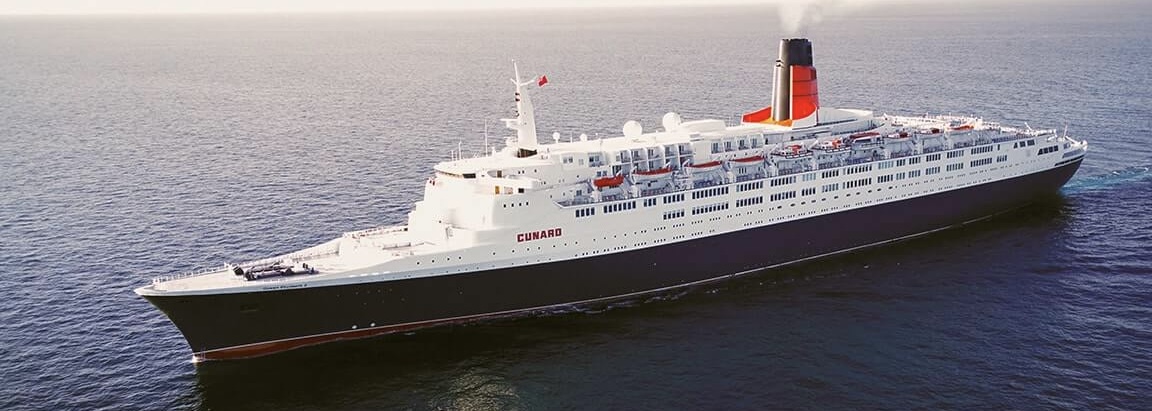
Queen Elizabeth 2
Cunard Line · 1969 · Ship Guide
Overview
Queen Elizabeth 2—universally known as QE2—was Cunard’s jet-age successor to the great postwar Queens: a purpose-built liner designed to keep a scheduled North Atlantic service alive while also functioning as a highly flexible cruise ship. That dual identity is central to her historical footprint: one vessel, two business models, spanning the long transition from “line voyages” to the modern cruise industry.
Built at Clydebank by John Brown & Company as yard number 736, QE2 entered service in 1969 and became Cunard’s flagship for decades. In curatorial terms, she is unusually “well-documented”: printed ephemera, onboard programmes, menus, sailing cards, shipboard newsletters, and official souvenir material exist in large quantity—but condition, edition-variance, and later reprints make careful cataloging important.
Evidence-first note: “QE2” is both a nickname and a branding mark used on countless souvenirs. For publish-ready attribution, aim to capture: (1) whether the object is line voyage or cruise context, (2) a dated itinerary, (3) an onboard venue/department marker, and (4) any printing codes or edition notes when present.
Key Facts
Design & Construction (Context)
QE2 belongs to a very specific design moment: the jet age, when scheduled ocean crossings were no longer the default way to travel, but still carried symbolic and commercial weight. Cunard’s solution was a ship that could maintain a transatlantic timetable in peak season and then pivot into cruise service—an intentional “two lives per year” operating logic that shaped everything from public rooms to deck planning.
For collectors, the most useful interpretive lens is not “luxury” in the abstract, but system design: what the ship needed to do (schedule, speed, sea-keeping, all-weather operation) versus what it needed to signal (modern British prestige, Cunard continuity, and a curated onboard identity). That tension is visible in the printed record—especially brochures and onboard programmes that blend ocean-liner language with cruise marketing.
Service History (Summary)
1969–1970s: North Atlantic liner service + cruising. QE2 entered service on the Southampton–New York run in 1969 and quickly became the line’s central public symbol. Throughout her career, she combined scheduled crossings with cruising and special voyages, producing a large volume of dated ephemera that can often be anchored to specific itineraries.
1986–87: Re-engining and “second career” machinery profile. The diesel-electric conversion is one of the defining technical events of her life. When cataloging engineering-related artifacts (brochures, technical press, onboard notices), it’s useful to identify whether the piece is pre- or post-re-engining, as that affects even seemingly “soft” materials like souvenir booklets and deck plans.
1982: Falklands troopship episode. QE2’s requisition and conversion for troop transport created a distinct documentary trail—temporary modifications, official messaging, and later commemorative material. Many items sold as “Falklands QE2” are later souvenirs; date and print provenance matter.
2004–2008: Final era as the last classic Cunard liner in fleet service. With Queen Mary 2 taking the flagship role in the 2000s, QE2’s status shifted toward heritage-in-motion. Her retirement in November 2008 triggered an immediate wave of farewell publications—some official, many unofficial.
2008–present: Preservation in Dubai. QE2’s survival as a floating hotel and visitor attraction makes her unusual among major postwar liners: she remains physically present, which continues to generate new “heritage merchandise.” Curator rule of thumb: always separate service-era artifacts from preservation-era souvenirs unless the collecting goal explicitly includes both.
Falklands Requisition
In May 1982 the British government requisitioned QE2 for service during the Falklands conflict. Cunard records that she sailed south carrying roughly 3,000 troops, a dramatic temporary reversal of her peacetime role as liner and cruise ship.
The episode belongs to a long Cunard tradition of large passenger ships being drawn into government service during national emergencies. For cataloging, wartime material from 1982 should be separated from both ordinary transatlantic ephemera and the ship's later cruise-era identity.
The 1986–87 Machinery Transformation
QE2's most consequential technical refit replaced her original steam-turbine machinery with a diesel-electric plant built around nine MAN B&W engines. The change reduced fuel consumption and extended the commercial usefulness of a ship conceived in the 1960s into a very different operating environment.
That refit is a major dating boundary. Technical drawings, engine-room photographs, and engineering literature from before and after the conversion document fundamentally different propulsion systems within the same ship.
Why QE2 Matters
QE2 survived because she was not confined to a single business model. She could still make a fast North Atlantic crossing, but she also adapted to long cruises, fly-cruise packages, and changing passenger expectations. Her career is therefore one of the clearest bridges between the traditional ocean liner and the modern cruise ship.
Interpretive Notes
QE2 is a best-case ship for evidence-first collecting because so many objects can be securely dated by itinerary, onboard venue, or event. It’s also a worst-case ship for overconfident attribution because the market is saturated with undated souvenirs and later “nostalgia” printings. Strong attributions usually include at least one hard anchor: a dated sailing card, a programme tied to a named voyage, a menu with a date/venue, or an operational marker (class, dining room, shipboard department).
Practical cataloging split that works well: Steam-turbine era (1969–1986) vs Diesel-electric era (1987–2008) vs Dubai preservation era (2008–present). That framework keeps technical claims honest, prevents “QE2 conflation,” and makes collections easier to browse.
Evidence-first ship guideSources (Selected)
Use these as a starting index. For publish-critical specs (tonnage by year, official capacities by configuration, precise refit scopes), corroborate with registers, yard documentation, or institutional archives where available.
- Ocean Liner Curator — Sources (master bibliography)
- Wikipedia — Queen Elizabeth 2 (starting index; corroborate key facts)
- University of Glasgow Archives — “Ship number 736” (build context)
- University of Glasgow Archives — launch tickets for Ship No. 736
- Maritime Reporter / MarineLink — QE2 repowering (1988 technical trade coverage)
- QE2 Dubai — official hotel site (current status and visitor context)
- Accor — Queen Elizabeth 2 (Dubai) listing (current operator context)
- Wikipedia — SS Antilles (1971 rescue context; cross-check to primary reporting)
- Cunard — QE2 requisition for the 1982 Falklands campaign
- Cunard — company history including QE2 service and re-engining context