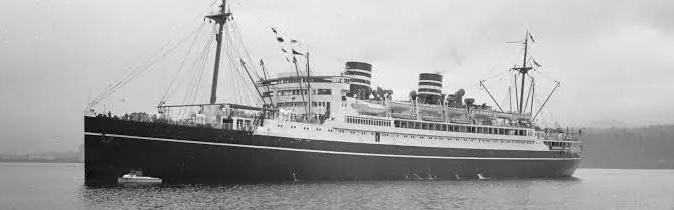
Asama Maru
Nippon Yusen Kaisha (NYK Line) · completed 1929 · Ship Guide
Overview
Asama Maru was one of the leading Japanese passenger liners of the interwar Pacific. Mitsubishi Shipbuilding at Nagasaki built her for Nippon Yusen Kaisha's high-profile route linking Japan with Hawaii and the west coast of the United States. She was launched on 30 October 1928, completed on 15 September 1929, and entered service that autumn.
The previous guide incorrectly treated 1929 as her launch year. NYK's own museum records identify 1929 as the completion year, while contemporary and specialist engineering sources place the launch in October 1928. The distinction matters because Asama Maru belonged to a coordinated three-ship modernization program with Tatsuta Maru and Chichibu Maru.
Her career crossed three very different historical roles: luxury trans-Pacific liner, subject of an Anglo-Japanese diplomatic crisis in 1940, and wartime transport. She was finally torpedoed and sunk by USS Atule in the South China Sea on 1 November 1944.
Key Facts
NYK's museum gives 16,947 gross tons and 20.71 knots; Lloyd's-derived and later references often give about 16,975 tons and 21 knots. These are source/measurement differences, not evidence of a separate ship.
A New Japanese Pacific Flagship
Asama Maru was part of Japan's effort to compete directly in the premier trans-Pacific passenger trade. Contemporary engineering coverage described her as the first of three large Japanese-built motor liners for the San Francisco service. Her four Sulzer-pattern diesels and quadruple-screw arrangement marked a clear move away from the steam machinery that had dominated earlier generations of long-distance passenger ships.
NYK's own museum presents the ship as one of the luxury liners of the early Shōwa era. The company's Pacific route carried passengers and commercially important cargo between Japan, Hawaii, and North America, making the vessel part of both tourism and trade rather than a prestige project detached from ordinary economics.
Record Passages and Peacetime Service
Asama Maru made a notably fast inaugural crossing to California and improved her own performance soon afterward. Contemporary reporting treated the ship's speed as evidence that Japanese shipbuilding had entered the front rank of Pacific passenger service.
In September 1937 she was driven ashore at Hong Kong during a typhoon. Salvage required months of work and substantial lightening of the vessel, but she was successfully refloated and returned to service in 1938. That episode is useful context for photographs showing the ship aground or under repair.
The 1940 Asama Maru Incident
On 21 January 1940, HMS Liverpool stopped Asama Maru off Japan and removed twenty-one German nationals. Some were associated with the crew of the scuttled German liner Columbus. Because Japan was still formally outside the European war, the boarding became a diplomatic dispute over belligerent rights and neutral shipping.
The incident should be treated as a specific event, not as shorthand for the ship's entire prewar career. Contemporary diplomatic records and newspapers are especially valuable because later retellings often compress the legal and political details.
Wartime Service and Loss
Before and after Japan's entry into the Pacific War, Asama Maru was used for state-directed transport. NYK history records her participation, with other company ships, in exchanges of diplomats and civilians. She also carried military personnel, civilians, and prisoners during the wider wartime transport effort.
On 1 November 1944 USS Atule torpedoed Asama Maru in the South China Sea near the southern end of Formosa. The sinking ended a fifteen-year career that had begun as a showcase of Japanese civilian maritime modernization.
Interpretive Notes
Use the correct date anchor: “1929” is appropriate for completion and entry into service, but the ship was launched in 1928.
Differentiate civilian and wartime identities: NYK menus, brochures, passenger lists, and Pacific-route advertising belong to a different context from government transport records or wartime photographs.
Do not reduce the ship to the 1940 incident: the interception is historically important, but Asama Maru was also a major commercial liner with a decade of prewar Pacific service.
Evidence-first ship guideSources (Selected)
- Ocean Liner Curator — Sources (master bibliography)
- NYK Line / NYK Maritime Museum — Asama Maru model and specifications
- NYK Maritime Museum — interwar passenger-liner context
- U.S. Naval Institute Proceedings (1930) — contemporary engineering note on Asama Maru
- Derby Sulzers — machinery and service chronology